What is an MCP Server and Why Is It a Security Blind Spot?
An MCP server is a gateway that lets an AI agent connect to and use external tools, APIs, and enterprise data sources. The Model Context Protocol standardizes how an agent discovers what tools are available, invokes them, and receives results. If the agent is the brain, MCP servers are how it reaches out and touches your systems.
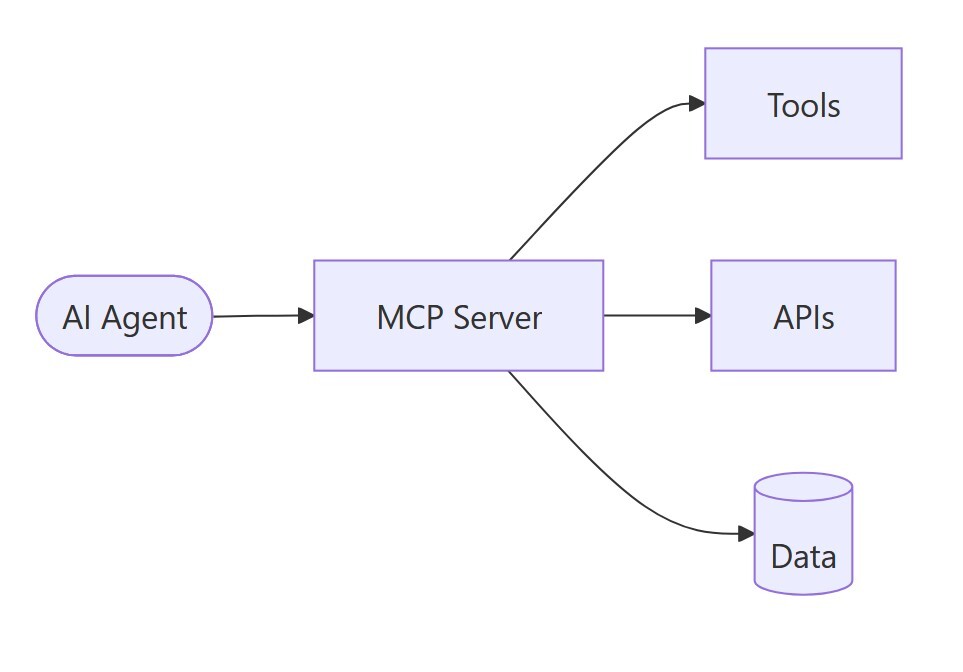
Think of an MCP server as an app store for AI agents. Each connected server advertises a set of tools, a database query function, a ticketing API, a file reader, and the agent decides which ones to call to complete a task.
NOTE: Microsoft’s Cloud Adoption Framework names MCP explicitly as a development standard within its agent governance model, sitting alongside the Agent-to-Agent protocol at the foundation of how agents operate.
Why traditional controls fail here
If you are a security or network engineer, then you have realized that traditional firework or authorization is not going to work.
Why? Well, network firewalls inspect packets and ports. User-based permissions check who a person is. Neither understands the context of an agent action: what the agent is, what purpose it is serving, or what data it is reaching through a tool call. An agent might hold a valid credential and make a perfectly well-formed request that still violates policy, because the request is scoped to the wrong purpose or pulls data the task never needed.
“ To control and monitor MCP server access, you have to govern the action, not just the model.”
This is the difference between traditional AI governance and agentic governance. Palo Alto Networks frames traditional AI governance around output risk (what a model says) and agentic governance around action risk (what an agent does), since agents can inherit credentials, access APIs, and trigger transactions without human confirmation. To control and monitor MCP server access, you have to govern the action, not just the model.
Monitoring should focus on the MCP server layer itself:
- Which tools agents access, how those tools perform
- Whether usage patterns look normal or suspicious .
This is precisely the layer legacy security stacks ignore.
Top Threats from Uncontrolled MCP Server Access
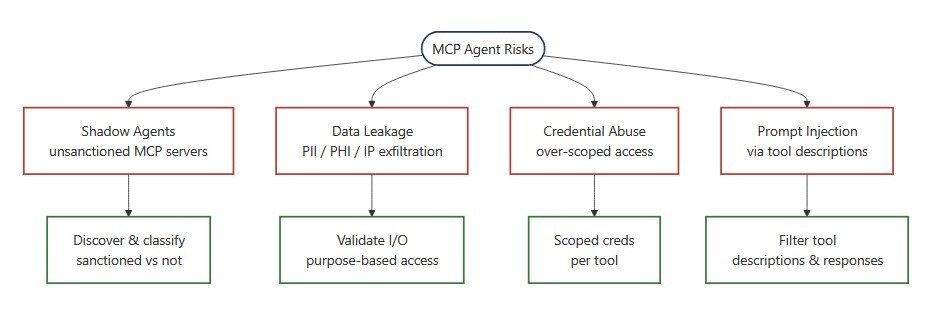
When MCP connections go ungoverned, the risks are concrete and high-impact. Here are the four that matter most.
“ You cannot block what you have not discovered!”
Unauthorized (“shadow”) AI agents
Developers and business teams routinely connect unvetted agents to enterprise data through unsanctioned MCP servers, often without security review. Zenity notes that most enterprises already have more agents in production than they realize, many created without any review. Classifying servers as sanctioned versus unsanctioned is the prerequisite step before any enforcement conversation can begin. You cannot block what you have not discovered.
Data leakage and exfiltration
An agent connected to enterprise data can be steered into extracting sensitive records, PII, PHI, or proprietary IP, through tool calls that look routine. A single query that joins customer data with internal financials, surfaced to the wrong agent for the wrong purpose, becomes an exfiltration event. Runtime enforcement at the MCP layer prevents data exfiltration by validating inputs and outputs and blocking unsafe actions before they execute.
Trust3 AI addresses this directly by hard-coding guardrails into its Purpose-Based Access Control agent to prevent AI agents from leaking sensitive cross-departmental data (Trust3 AI). Access is bound to declared task intent, so an agent working on a marketing task cannot quietly pull from an HR data source.
Credential abuse and privilege escalation
Agents frequently inherit broad credentials, and a compromised agent or a malicious MCP server can abuse those credentials to move laterally. The fix is dedicated, scoped credentials per tool or integration rather than convenient shared service accounts. Without scoping, one over-permissioned agent becomes a path to systems far beyond its job.
Prompt injection via tool descriptions
MCP servers advertise their tools using natural-language descriptions, and those descriptions feed straight into the agent’s reasoning. Malicious instructions hidden in a tool description can hijack the agent’s loop and push it toward unauthorized actions. Validating inputs and outputs at the MCP layer blocks prompt injection delivered through tool responses and descriptions. For more on how injection attacks target the agent’s reasoning and credential boundaries, see Trust3 AI’s guide to agent security.
A Framework for Governing MCP Server Access
Effective MCP governance follows a clear sequence. Each step builds on the one before it, mirroring the structured approach used by the most-cited governance frameworks.

Step 1: Discover and inventory every agent and MCP connection
You cannot govern what you cannot see. The first practice in any MCP security program is maintaining a complete inventory of all MCP servers and clients in your environment. That means automatically discovering every agent, custom-built and third-party, and every MCP server it connects to, then classifying each server as sanctioned or unsanctioned.
Discovery should capture who built each agent, what platforms it runs on, which MCP servers it connects to, what tools it can invoke, and what data it can reach. This is the inventory function in Trust3 AI’s Agent DOS model, and without it, every other control is theoretical. Trust3 AI runs automatic discovery to find every agent, including the ones the security team never approved.
Step 2: Define and enforce access policies
Role-based access control (RBAC) tells you who an agent is, but not what it should access right now for a specific task. Agentic systems need finer-grained models.
Purpose-Based Access Control (PBAC) is the strongest fit for agents: access is granted based on the declared intent of a task and expires automatically when the task ends. Trust3 AI’s PBAC agent ties data access to project intent and enforces it natively, evaluated per request before any data moves (Trust3 AI). The platform also supports Attribute-Based Access Control (ABAC) and Tag-Based Access Control (TBAC), so policies can react to data sensitivity, agent attributes, and tags (Privacera). Access policies should bind tightly to a single agent, a single function, and the minimum scope of actions required.
Step 3: Implement real-time monitoring and threat detection
Good monitoring logs every connection, tool call, credential exchange, and data flow, then keeps a tamper-evident record for compliance and forensics. Runtime observation, not configuration review, is the current state of the art for detecting unauthorized tool usage. Detection works by watching what agents actually do when they connect, not what config says they should do.
Continuous monitoring catches configuration drift, behavioral anomalies, and silent privilege escalations, using runtime scoring, behavioral baselines, and end-to-end audit logs. Network traffic analysis can flag MCP communications on non-standard ports and unusual data volumes to AI service domains. Watch for agents connecting to MCP servers without authentication, an open door that should be blocked before it is exploited.
Step 4: Automate enforcement and remediation
Detection alone does not stop a breach. The system has to act. Runtime guardrails should block unauthorized connections or tool calls the moment they happen, and every control needs a kill switch: a single operator action that immediately suspends a misbehaving agent (Trust3 AI).
Trust3 AI’s Agent Security is the enforcement engine of its control plane, evaluating every action, creating audit records, and routing remediation in real time. Guardrails sit outside the model’s reasoning, so a compromised model cannot route around them. This is where auditing AI agent and LLM access to data becomes operational rather than after-the-fact.
How Trust3 AI Delivers Proactive MCP Security
Trust3 AI, formerly Privacera, brings these framework steps together in one platform built for the agentic era. Here is how its capabilities map to the MCP security gap.
A unified platform for discovery, observability, and security
Trust3 AI organizes agent governance around three pillars, Discovery, Observability, and Security, that become one console (Trust3 AI). Instead of stitching together a discovery tool, a monitoring tool, and an enforcement tool, security and compliance teams get a single control plane powered by a unified trust layer (Trust3 AI). Identity and purpose propagate through every hop, even three hops deep as agents call MCP servers, A2A handoffs, and gateways.
Proactive enforcement with Trustscore
Launched on April 1, 2026, Trustscore is a real-time, quantified risk rating for every AI agent in production (AICompetence). It converts compliance policies, written in plain language, into a single auditable risk score across four dimensions: Security, Safety, Compliance, and Accountability (PR Newswire).
What sets it apart is enforcement timing. Trust3 AI enforces compliance before an agent reaches production by tying policy directly to developer constraints that cannot be bypassed at build time (Morningstar). When an agent’s Trustscore falls below threshold, remediation is automatic, documented, and tied directly to the triggering policy. Trustscore also gives clear visibility into what AI agents are executing and what sensitive data they access.
Purpose-Based Access Control for least-privilege
Trust3 AI enforces least-privilege by scoping access to a declared purpose with just-in-time grants and auto-expiring scopes, with zero standing access (Trust3 AI). Purpose is evaluated per request at Snowflake, Databricks, and BigQuery, combining identity, purpose, and data classification in one policy decision. This governs the full AI lifecycle, from the moment an agent is built through every request it makes in production.
A hardened MCP layer
Trust3 AI treats every MCP server as untrusted and controls how agents connect to tools, data, and external systems in real time (Trust3 AI). It verifies servers before agents connect, scopes credentials so they are never exposed beyond what a single task requires, and inspects content to strip injected instructions. The result is a controlled execution layer where agent access is always scoped, inspected, and traceable, integrated natively without proxies or rewrites.
Tamper-evident audit trails
Every prompt, retrieval, tool call, and data access is captured live with full context attached (Trust3 AI). That produces one-click audit evidence for the EU AI Act, HIPAA, and NIST, whose full enforcement of the EU AI Act begins in August 2026 (Morningstar). The evidence trail comes from actual system activity, not self-reported attestations.
Comparing Enterprise Platforms for AI Agent Governance
Several platforms address parts of this problem. Here is how the leading options compare for securing and governing AI agents accessing enterprise data.
Zenity focuses on AI Security Posture Management, giving visibility into agent configurations, permissions, and runtime behavior to handle risks like tool abuse and data exposure. Its strength is discovery and posture. Trust3 AI extends past posture into proactive enforcement at the data access and protocol layer, blocking violations rather than only surfacing them.
Palo Alto Networks leads on thought leadership, defining agentic governance as the structured management of delegated authority in autonomous systems and citing McKinsey’s estimate that agentic AI could unlock $2.6T–$4.4T annually while only 1% of organizations consider their AI adoption mature. Trust3 AI operationalizes those concepts with a unified, data-aware control plane that moves from framework to runtime implementation.
Immuta positions as a data-provisioning company, treating AI agents as first-class participants in the data ecosystem and integrating with Databricks, Snowflake, BigQuery, and LLMs including Claude and Gemini. Its center of gravity is provisioning data. Trust3 AI’s architecture is agent-native, governing the agent’s actions and its protocol-level MCP interactions, not just the data it provides.
Most enterprises need both an MCP gateway layer that controls agent access to tools and a security layer that detects and responds to threats. Trust3 AI’s differentiator is combining agent discovery, AI-native access control through PBAC, and protocol-level MCP hardening into a single proactive governance platform. For broader market context, Reco’s roundups cover the wider field of AI security tools and AI governance tools for enterprises.
Conclusion
MCP servers are a real risk for any enterprise adopting agentic AI, but a manageable one. The path runs through three pillars: comprehensive discovery of every agent and MCP connection, real-time monitoring with tamper-evident audit trails, and proactive automated enforcement grounded in least-privilege access.
Doing this at scale, across multiple clouds, frameworks, and data platforms, calls for a unified platform rather than a patchwork of point tools. Trust3 AI brings discovery, observability, and security into one control plane and enforces policy before agents ever reach production, so organizations can adopt AI with confidence instead of crossing their fingers.
Frequently Asked Questions
How do you enforce least-privilege access for AI agents?
Move beyond user roles to Purpose-Based Access Control (PBAC), where permissions are scoped to a specific declared task and time-bound rather than granted by job title. Credentials should be scoped per tool call with auto-expiring grants and zero standing access, so an agent only ever touches the data its current task requires. Trust3 AI evaluates purpose per request before any data access occurs.
How can you audit an AI agent’s access to enterprise data?
You need a system that captures a complete, tamper-evident log of every prompt, tool call, data query, and credential exchange, with each action linked back to the agent and the originating user. That trail supports forensics after an incident and produces the audit evidence regulations like the EU AI Act, HIPAA, and NIST require.
What is the first step to securing AI agents?
Discovery, every time. You need a complete, automated inventory of all agents, custom-built and third-party, and the MCP servers they connect to before any control can be applied. Classify each server as sanctioned or unsanctioned, then layer access policy, monitoring, and enforcement on top of that foundation.
Related Articles