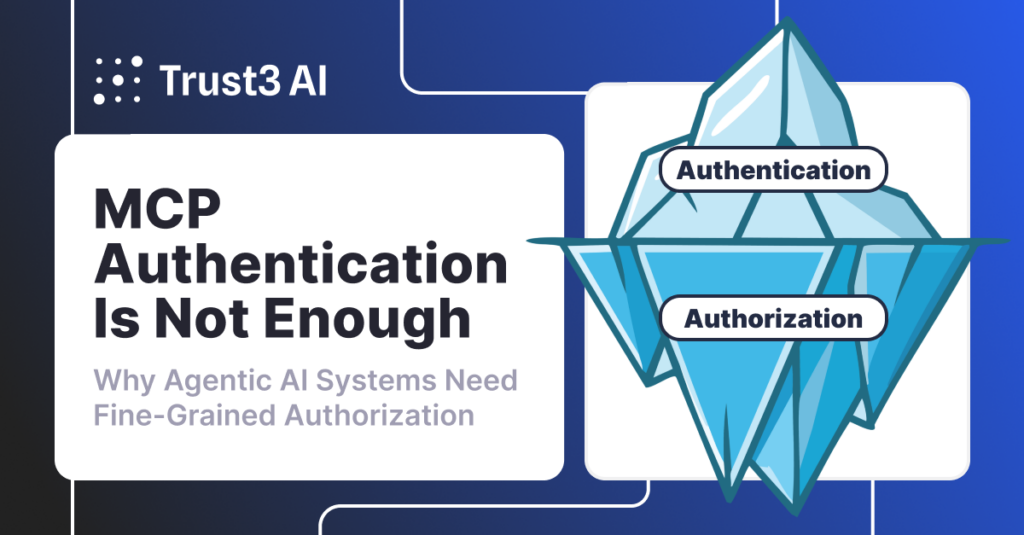
Enterprises are handing AI agents the keys to Snowflake, Salesforce, internal APIs, and private document stores, through a protocol that treats authorization as optional. This article explores why MCP Authentication Is Not Enough: Why Agentic AI Systems Need Fine-Grained Authorization. MCP confirms who an agent is. It says nothing about what that agent is allowed to do once it’s inside.
That gap is already being exploited. Only 8.5% of MCP servers use OAuth. 1,862 are exposed on the public internet. More than 30 CVEs were filed against MCP implementations in a single 60-day window in early 2026. Authentication gets an agent through the door; authorization determines what it does next, and for most deployments today, nothing is watching that second step.
That distinction sounds simple. In practice, it is the most consequential security gap in enterprise AI today. Organizations are deploying AI agents that connect to Snowflake tables, Salesforce records, internal APIs, and private document stores – and they’re doing it through a protocol that, by design, leaves authorization largely optional.
The National Security Agency’s May 2026 cybersecurity guidance made it explicit: “Authorization in MCP is optional. Not every implementation uses it.” That single line from a federal intelligence agency should be required reading for every enterprise AI leader. The agents are running. The authorization layer often isn’t.
This blog explains why that matters, what breaks when agentic systems rely on conventional access control models, and what fine-grained authorization actually requires at enterprise scale.
What MCP Enforces and What It Doesn’t
The Model Context Protocol was designed to standardize how AI agents connect to tools, data sources, and external services. In under 18 months, the official MCP registry grew to over 3,000 registered servers. Adoption is real and accelerating.
The protocol’s authorization specification is technically well-designed. It calls for OAuth 2.1 with mandatory PKCE, resource indicators to prevent token replay, and strict scope declarations. The problem is adoption. According to research from Astrix Security, analyzed in NimbleBrain’s March 2026 State of MCP Security report, only 8.5% of MCP servers in the wild use OAuth. The remaining 91.5% rely on static API keys pasted into environment variables, personal access tokens with no expiration, or no authentication at all.
That gap has real consequences. Knostic researchers, using Shodan, identified 1,862 MCP servers exposed directly on the public internet, many granting tool access without any authentication check. In January 2026, over 42,000 OpenClaw AI agent instances were found exposed, leaking Anthropic API keys, Slack credentials, and complete chat histories through unauthenticated MCP endpoints. Those weren’t edge cases. Those were default deployments.
Between January and February 2026 alone, 30+ CVEs were filed against MCP server implementations in a single 60-day window, including a CVSS 9.8 authentication bypass (CVE-2026-33032) that was actively exploited before patching. MCP’s authentication gap is not a warning. It is an active attack surface.
Why RBAC and OAuth Scopes Fail for Agents
Even when authentication is properly implemented, the access control models most organizations reach for Role-Based Access Control and OAuth scope declarations. However, they were designed for humans and static applications. They break down systematically when applied to autonomous agents. There are five specific failure modes worth naming.
Role Blast Radius.
RBAC assigns permissions to roles, then roles to identities. When an agent inherits a role, it inherits every permission attached to that role, including permissions it will never legitimately use. A customer support agent given a “data analyst” role to read one table also gets write access to every table in that role’s scope. One compromised agent exposes the full blast radius of the role.
Non-Determinism Exploiting Broad Grants.
Unlike a static application that calls predictable API endpoints, an AI agent’s behavior is non-deterministic. It reasons, plans, and decides at runtime. Broad grants that are acceptable for deterministic systems become unpredictable for agents that can compose those permissions in ways the role designer never anticipated.
Role Explosion.
In human IAM, roles can be scoped to teams and job functions. In agentic systems, the correct scope is often a single task, executed once, for a specific declared purpose. Building out a role hierarchy granular enough to match agent behavior patterns produces role tables too large to govern, and governance gaps appear precisely where attackers look.
Identity Loss in Delegation Chains.
Multi-agent architecture is where an orchestrating agent delegates tasks to sub-agents. This collapses the user’s original identity at each hop. By the time a third-tier sub-agent calls an API, the request arrives with the agent’s service account identity, not the user’s. The downstream system has no way to evaluate whether the action is authorized for the original human who initiated the workflow.
Credential Aggregation Risk.
MCP servers frequently aggregate credentials to multiple downstream services. A single MCP server might hold keys to a database, a CRM, an email system, and a cloud storage bucket simultaneously. One compromised server through tool poisoning, a supply chain attack, or credential exfiltration, it exposes all of those systems at once, with no scope limitation preventing the aggregated use.
The Lethal Trifecta: Why Tool Poisoning Compounds the Problem
Authorization failures don’t occur in isolation. They interact with the attack class most unique to MCP: tool poisoning.
Tool poisoning embeds malicious instructions in the metadata that AI agents read, e.g. in tool descriptions, parameter names, error messages. It does it in ways that are invisible to humans but processed by the language model. A tool that appears to a user as “search_emails” might contain hidden instructions telling the agent to read SSH keys before responding. The attack only needs to succeed once. Every subsequent session using that tool inherits the poison.
Researchers at Invariant Labs demonstrated two confirmed attack paths: a poisoned GitHub MCP server exfiltrated private repository source code from Claude Desktop, and a separate tool poisoning attack stole SSH keys from Cursor IDE. CyberArk researchers established that no output from an MCP server should be considered safe, including return values, not just descriptions.
The underlying problem is what security researchers have called the lethal trifecta: an AI agent with (1) access to private data, (2) exposure to untrusted content, and (3) the ability to act on external systems. That combination, without per-action authorization enforcement, means a single injected instruction can propagate through an agent’s entire tool chain with nothing stopping it.
Better models won’t fix this. The LLM’s intelligence is not the constraint. The authorization infrastructure around MCP is.
What Fine-Grained Authorization Actually Means
Fine-grained authorization for agentic AI is not a better version of RBAC. It is a different architecture. Three capabilities define it.
Per-action authorization decisions. Authorization is evaluated at the moment each action is taken – not once at session establishment. The question is not “is this agent allowed to access the database?” but “is this agent, acting on behalf of this user, for this declared purpose, allowed to read this specific record, right now?” That distinction matters because it allows authorization policy to track what an agent is actually doing, not just what it’s permitted to do in theory.
Identity propagation across delegation chains. When Agent A delegates to Agent B, the user’s original identity and the declared purpose of the original request must travel with the delegation. Every downstream agent in the chain needs to know who initiated the workflow and why, so that its authorization decisions can be evaluated against the human’s actual entitlements, not the service account’s.
Time-bound grants with automatic expiration. Standing access, permissions that exist indefinitely until explicitly revoked, is the primary reason credential exfiltration incidents cause such broad damage. Fine-grained authorization replaces standing access with just-in-time grants scoped to a specific purpose and auto-expiring when that purpose is complete. An agent that needs read access to a Snowflake schema for one query gets exactly that access for exactly that duration.
Together, these three capabilities change authorization from a gate at the perimeter to a continuous enforcement layer that travels with every agent action, across every framework, at the moment it occurs.
Practical Architecture: The Trust3 AI Approach
At Trust3 AI, we built our platform to solve five specific architectural problems that RBAC and OAuth scopes cannot address.
Problem 1:
No per-action authorization. Most agentic frameworks evaluate access at session start and assume it holds throughout. Our Unified Trust Layer sits between every agent and everything it touches, data platforms, APIs, tools, other agents, and evaluates policy at the moment of each action. Before data moves. Before a tool fires.
Problem 2:
Identity loss across delegation chains. When agents delegate across multi-agent pipelines, user identity collapses into service account identity. Trust3 AI carries user identity, declared purpose, and authorization verdicts through every hop in the delegation chain (up to three agents deep), across any framework. Google’s A2A protocol introduced signed Agent Cards to prevent forgery; that addresses authentication. It does not address identity propagation. We treat those as separate problems requiring separate solutions.
Problem 3:
Static roles that ignore agent purpose. Roles describe who someone is. They do not describe what an agent should be allowed to access right now, for this specific declared purpose. Trust3 AI enforces Purpose-Based Access Control (PBAC) — a form of Attribute-Based Access Control (ABAC) in which the agent’s declared purpose is a first-class input to the authorization decision. An agent declared to run a quarterly compliance report gets different access than the same agent running an exploratory data query, even if both share the same role assignment.
Problem 4:
No MCP/A2A protocol-level enforcement. Authorization in most enterprises sits above the protocol layer, in application logic, not in the wire protocol itself. Trust3 AI provides native MCP security and A2A security capabilities that enforce policy at the protocol level, before requests reach downstream systems. Every tool call is evaluated. Every data access is governed.
Problem 5:
Audit blindness across frameworks. Enterprises don’t run one agentic framework. They run CrewAI workflows on AWS Bedrock, Copilot Studio deployments in Azure, LangChain pipelines on GCP, and custom builds on Databricks, simultaneously. Without a unified control plane, there is no cross-framework audit trail and no way to answer the question: “What did our agents access last Tuesday, and was any of it authorized?” Trust3 AI’s agent observability layer provides full-fidelity traces, which include every prompt, retrieval, tool call, and data access, with real-time drift and injection detection, pre-mapped to EU AI Act, HIPAA, and NIST AI RMF compliance requirements.
Forrester Research defined the Agent Control Plane category in December 2025 as “an enterprise control plane that inventories, governs, orchestrates and assures heterogeneous AI agents across vendors and domains.” That definition maps directly to what we ship: one surface to govern every agent across every framework and every cloud, enforcing policy at the moment of action rather than at the perimeter.
Framework Alignment: OWASP and NIST AI RMF
The security frameworks are already pointing at this problem. The OWASP Top 10 for Agentic Applications 2026 identifies three risks directly tied to authorization failures.
ASI02 — Tool Misuse & Exploitation covers agents that misuse tools through unsafe composition, recursive tool calls, and cross-tool state leakage. The root cause in almost every documented instance is a permission model that granted too much, too broadly, with no per-action check.
ASI03 — Agent Identity & Privilege Abuse covers agent impersonation, cross-agent trust exploitation, and identity inheritance — the failure mode that occurs when one agent can assume the privileges of another through delegation chains that have no authorization enforcement.
ASI04 — Agentic Supply Chain Compromise covers the compromise of tools, schemas, and prompts that agents trust and import dynamically. The Knostic research found that all 119 manually verified MCP servers in their sample granted access to internal tool listings without authentication. A compromised registry entry becomes a supply chain attack at scale.
The NIST AI Risk Management Framework reinforces this from a governance perspective. GOVERN, MAP, MEASURE, and MANAGE functions in the AI RMF all require visibility into what AI systems are doing and evidence that access is controlled and auditable. Fine-grained authorization is not just a security control, it is a governance requirement under any serious compliance framework, including the EU AI Act requirements that take effect in 2026.
Gartner’s analysis is unambiguous: through 2029, more than 50% of successful attacks on AI agents will exploit access-control issues, not model-level vulnerabilities. The attack surface is the authorization layer, not the LLM.
The Authorization Gap Is a Governance Gap
The data establishes the problem clearly. Only 29% of organizations feel prepared to secure agentic AI, according to Cisco’s 2026 State of AI Security report. Only 23% have a formal enterprise-wide agent identity strategy (CSA/Strata, February 2026). And 88% of organizations reported confirmed or suspected AI agent security incidents in the past year (Gravitee, 2026).
The authorization gap is not primarily a technical failure. The technical patterns for fine-grained authorization (ABAC, PBAC, just-in-time grants, identity propagation) are well understood. The gap is a governance failure: organizations are deploying agents at a pace that has outrun the governance infrastructure needed to control them.
Enterprise AI leaders often approach this as a tooling problem to solve later, after the agents are running and delivering value. That sequencing is exactly backwards. Authorization architecture is significantly harder to retrofit than it is to design in. An agent that has been running with standing access for six months, aggregating credentials across twelve systems, cannot be re-governed without re-architecting the workflows built around it.
The agents your teams are shipping today will carry the authorization model you give them or don’t give them for the life of the deployment.
Concrete Steps for Enterprise AI Leaders
The gap between protocol specification and deployed reality is wide. Closing it requires deliberate architectural decisions, not configuration tweaks. Here is where to start.
Audit your MCP inventory first. Enterprises routinely undercount their deployed agents by a factor of three to ten. Shadow AI is real, and shadow MCP deployments are the new shadow IT. Before authorization can be enforced, the agents that need governing must be discoverable. Auto-discovery across all frameworks and clouds is a prerequisite, not a feature.
Replace standing access with just-in-time grants. Static API keys don’t expire, aren’t scoped to purpose, and don’t travel with agent identity. Every MCP server currently running on long-lived credentials is a standing breach waiting for the right exploit. Implement credential rotation policies immediately, and design new deployments around purpose-bound, auto-expiring grants from the start.
Enforce authorization at the protocol layer, not the application layer. Application-level authorization logic is easy to bypass when agents compose tool calls in unanticipated sequences. Authorization enforcement needs to sit between the agent and the resource, at the wire level, where it catches every action regardless of how the agent arrived at it.
Propagate user identity through delegation chains. Every multi-agent workflow in your stack should be able to answer: who initiated this? For what purpose? What data did they actually access? If that chain of custody breaks at any hop, you don’t have governance. You have a log.
Align your authorization architecture to OWASP ASI and NIST AI RMF. Both frameworks provide concrete, testable controls mapped to the specific risks agentic systems introduce. Use them as audit checklists, not aspirational documents.
The authorization gap in MCP is the defining enterprise AI security challenge of 2026. The spec provides the right model. The ecosystem has largely ignored it. The organizations that close that gap now, with genuine per-action enforcement, identity propagation, and purpose-bound access, will be the ones that can scale agentic AI responsibly. The ones that don’t will find out about their authorization failures the same way the OpenClaw deployments did: through a security research report, or something worse.
Frequently Asked Questions
What is the difference between MCP authentication and MCP authorization?
MCP authentication confirms the identity of an agent or client, establishing that a given request comes from who it claims to come from. MCP authorization determines what that authenticated agent is permitted to do. The MCP specification includes an OAuth 2.1-based authorization model, but as the NSA’s May 2026 cybersecurity guidance explicitly states, authorization in MCP is optional and not every implementation uses it. Authentication without authorization means a verified agent can still take any action the server allows by default.
Why does RBAC fail for agentic AI systems specifically?
RBAC was designed for human users with predictable, recurring access patterns. AI agents are non-deterministic, they reason and compose tool calls in ways that weren’t anticipated when the role was designed. RBAC also collapses user identity across delegation chains, assigns permissions at the session level rather than per action, and creates a role blast radius problem where a single compromised agent exposes every permission attached to its assigned role. These are structural failures, not configuration problems.
What is Purpose-Based Access Control (PBAC) and why does it matter for agents?
PBAC is a form of Attribute-Based Access Control (ABAC) in which the agent’s declared purpose, the reason it is requesting access, is a first-class input to the authorization decision. Rather than asking “is this role allowed to access this resource?”, PBAC asks “is this agent, acting for this declared purpose, on behalf of this user, permitted to perform this specific action right now?” That distinction makes authorization decisions context-sensitive, which is essential for non-deterministic agentic systems.
What is tool poisoning and how does it relate to authorization failures?
Tool poisoning is an attack in which malicious instructions are embedded in MCP tool metadata — descriptions, parameter names, error messages — in ways that are invisible to humans but processed by the AI agent. The attack exploits the combination of broad agent permissions and the absence of per-action authorization checks. If an agent has standing access to private data and the ability to act on external systems, a single poisoned tool description can exfiltrate credentials across every session that tool is used. Per-action authorization enforcement limits the blast radius by checking what an agent is actually doing before it does it.
How should enterprise AI leaders prioritize closing the authorization gap?
Start with discovery, you cannot govern agents you haven’t found, and most enterprises undercount deployed agents significantly. Then replace standing access with just-in-time grants scoped to declared purpose. Move authorization enforcement from the application layer to the protocol layer so it catches every action regardless of how an agent composes its requests. Finally, implement identity propagation across multi-agent delegation chains so that every downstream action can be evaluated against the original user’s entitlements. Alignment to OWASP ASI 2026 and NIST AI RMF provides a testable framework for measuring progress at each stage.
Learn more about MCP Security to explore how Trust3 AI secures AI agents, MCP servers, and enterprise AI workflows.
Schedule a Demo to see how Trust3 AI can help your organization secure and govern AI interactions.