Most data access problems aren’t really security problems. They’re waiting problems. In today’s AI world, organizations are moving fast and this wait time is a big hurdle to the productivity of users, especially the business user.
Let’s look into an example:
An analyst needs three columns from a new table to finish a forecast. A data scientist needs a sample of customer records to test a model. In theory the data is right there in the lake. In practice, they file a ticket, an administrator hand-writes a set of AWS Lake Formation grants, someone reviews it, and a week later the request is fulfilled by which point the deadline has moved or the question has changed.
Multiply that by every analyst, every new dataset, and every new query engine, and access provisioning quietly becomes one of the largest drags on a data team’s output. The irony is that Lake Formation is good at enforcing access. The bottleneck is everything that happens before enforcement: deciding who should see what, expressing that as policy, and keeping it consistent as the estate grows.
Trust3 AI Eliminates the Wait Time
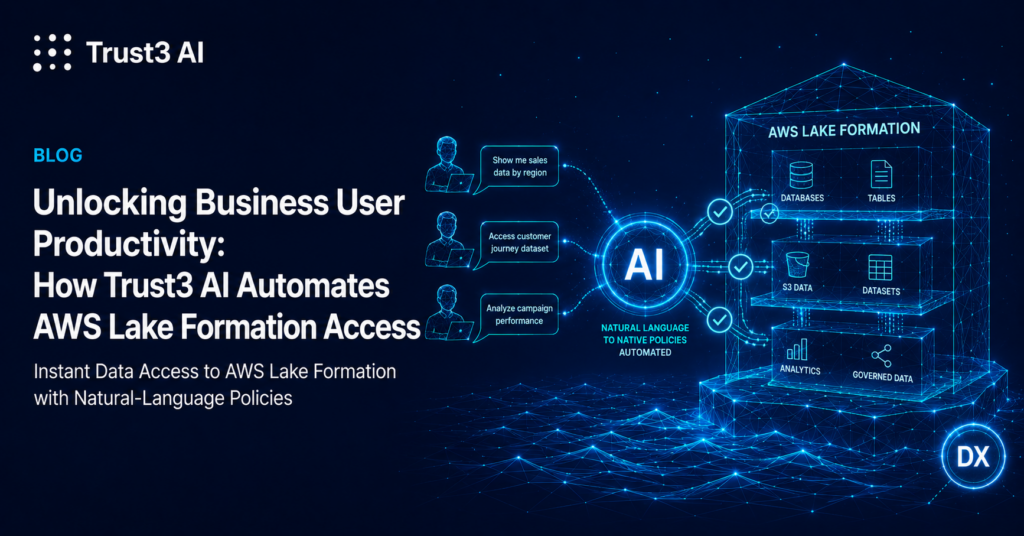
Trust3 AI is built to close this gap. It removes wait time for the business users. You author intent once, in natural language, and Trust3 AI translates it into native Lake Formation policy that AWS enforces directly. Below is how that works and why it shortens the path from “I need this data” to “here it is.”
A quick refresher on Lake Formation
AWS Lake Formation provides fine-grained access control over data registered in the AWS Glue Data Catalog and stored in Amazon S3. It can grant or deny at the database, table, column, row, and cell level, and once a grant is in place, Lake Formation enforces it consistently across the AWS analytics services such as Athena, Redshift Spectrum and EMR.
Lake Formation also supports tag-based access control (LF-TBAC), where you attach LF-Tags to catalog resources and grant permissions against the tags rather than against individual tables. That’s a meaningful step up from naming every resource one by one. But at enterprise scale teams still run into two limits.
Challenges with Lake Formation’s native tag-based access control
First, the policies themselves are authored and maintained inside Lake Formation, principal by principal, which is hard to operate consistently when hundreds of people and dozens of datasets are involved.
Second, Lake Formation governs only AWS-native sources. It does not extend to the Snowflake, Databricks, or Dremio engines that the same business users also query which leaves a sustainable governance gap
So the data is enforceable, but the administration of who-gets-what doesn’t scale, and it doesn’t follow users beyond AWS.
Where does Trust3 AI fit?
Trust3 AI provides one place to author your policies and it does native enforcement everywhere. It is built by the team behind Apache Ranger and Apache Atlas. It acts as a single policy administration point (PAP). You write access policy once, centrally, and Trust3 AI delegates enforcement to the native systems that actually sit in the data path. For an AWS lake, that native system is Lake Formation.
The important architectural detail is that there is no proxy hop. Trust3 AI doesn’t sit between the query and the data, adding latency and a new failure point. It synchronizes your policy into Lake Formation, and Lake Formation enforces it the way it always has. Trust3 AI lists Lake Formation alongside Unity Catalog, Snowflake, BigQuery, Dremio, Spark, and EMR as native enforcement targets, propagating a single policy set across all of them. A business user querying through Athena sees Lake Formation doing the enforcing; they never know Trust3 AI authored the rule.
The Policy Agent: write intent, not syntax
The piece that changes the day-to-day for business users is how policy gets created. Trust3 AI ships a set of specialist Trust Agents – Discover, Catalog, Policy, and Review – that handle governance work autonomously. The Policy Agent is the one that turns intent into enforceable rules.
Instead of hand-crafting Lake Formation grants, a governance or compliance owner expresses the policy in natural language.
For example:
Analysts in the EU marketing team can only see customer records for EU residents, with email and phone masked.
The Policy Agent converts that intent into a concrete access policy expressed as attributes and tags, and that policy is synced to Lake Formation for native enforcement. Trust3 AI describes this as connecting the policy a compliance officer authors in plain language directly to an enforced constraint, rather than leaving it as a document in a SharePoint folder that no system actually applies.
Two design choices in how those policies are expressed matter a lot for productivity:
1- Attribute-based instead of role-by-role.
Rather than writing a separate grant for every role-and-resource combination, Trust3 AI uses attribute-based access control (ABAC), where policy is expressed against user attributes and data tags. Trust3 AI reports customers collapsing large static policy sets dramatically this way – a global advertising and media network replaced roughly 2,000 catalog policies with about 20 dynamic ones, and a Fortune 50 media and telecom company reported a comparable reduction. Fewer policies to maintain means fewer places for access to silently break.
2- Purpose-based and time-bound.
Trust3 AI supports purpose-based access control (PBAC), where a grant is tied to a declared purpose and auto-expires when the work is done, leaving no orphan grants behind. A user gets exactly the access the task requires, for as long as the task lasts.
Why this makes business users faster
Put together, the model attacks the waiting problem from several directions.
New people get access on day one. Because policy is expressed against attributes (“EU marketing analyst”) rather than enumerated per person, a new hire who matches the attributes inherits the right access automatically – what Trust3 AI calls birthright access. No new ticket, no new grant.
Birth-right access
New datasets inherit governance automatically. The Catalog and Policy agents key off tags and metadata, so when a new table lands and is tagged, the existing policies that reference those tags apply to it immediately. Trust3 AI describes onboarding a new platform as inheriting existing governance from day zero – no rebuild. The same logic applies to a new table arriving in an already-governed lake.
Masking replaces blanket denial. Lake Formation can hide columns entirely, but a column the analyst can’t see at all is a column they have to request access to. With native masking and format-preserving techniques, Trust3 AI can show a usable but protected version – the last four digits of an SSN, a tokenized email – so the analyst gets a working dataset instead of an access-denied error and another ticket.
Consistency across every engine an Analyst touches. Because the same authored policy is enforced across Lake Formation and the non-AWS engines in the estate, a business user gets the same view of the data whether they reach it through Athena, EMR, Snowflake, or Databricks. They stop hitting contradictory permissions depending on which tool they happened to open.
The net effect Trust3 AI points to is in the elimination of wait time of access approval cycles from weeks to seconds, with reported productivity gains of up to 10x. Whether your own numbers land there or not, the mechanism is sound: you remove the manual, per-principal authoring step that was the actual bottleneck, while keeping enforcement exactly where it was.
What this looks like in practice
A reasonable rollout sequence on an AWS lake:
- Connect Trust3 AI to your AWS Glue Data Catalog and Lake Formation so it can read existing tags and resources and write policy back.
- Let the Discover and Catalog agents classify sensitive elements (PII, PHI, PCI) and tag the catalog, so policy has attributes to attach to.
- Use the Policy Agent to author intent in natural language – who, what data, what purpose, what masking.
- Trust3 AI syncs those policies to Lake Formation, which enforces them natively for Athena, Redshift Spectrum, EMR, and Glue, with the same policy extended to any non-AWS engines you’ve connected.
- The Review agent keeps watch – checking access against declared purpose and maintaining the audit trail for every query, every platform, every principal.
From the business user’s seat, none of that is visible. They ask for data and it’s there, correctly scoped, with sensitive fields masked rather than blocked. The administrator’s queue stops growing. And the security team gets something it rarely gets from a productivity win: tighter, more consistent enforcement, because least-privilege is now the default the system produces rather than a goal someone has to remember to hand-configure.
The bottom line
Lake Formation is a strong enforcement engine. What it doesn’t solve on its own is the human bottleneck of authoring and maintaining access at scale, or extending that access model beyond AWS. Trust3 AI puts a single, natural-language policy layer on top; author once with the Policy Agent, enforced natively in Lake Formation. In doing so turns access provisioning from a multi-day ticket into something that happens the moment a user or a dataset appears. The business users get their data faster; the security team gets cleaner, attribute-driven enforcement. The waiting goes away.
This post describes Trust3 AI capabilities as publicly documented as of June 2026. Specific results such as policy-count reductions and productivity multiples are figures Trust3 AI reports from named-anonymized customer deployments; you can validate against your own environment during a proof of value.