The conversation around data and artificial intelligence has officially shifted. We are no longer just marveling at the novelty of generative AI. Instead, we are asking hard questions about how to control it, scale it, and make it understand our businesses.
The Gartner Data & Analytics Summit 2026 in Orlando, Florida, made this transition incredibly clear. Thousands of data leaders gathered to untangle the complexities of AI governance, semantic context layers, and organizational readiness.

The overarching theme of the week was undeniable:
If your data lacks deep business context and proper governance, your AI initiatives will inevitably fail.
Over three action-packed days, analysts, and industry giants mapped out the future of enterprise data. We saw massive announcements and strategic shifts from major players, highlighting a collective race to build robust infrastructure for autonomous agents.
Here is a detailed look at the defining moments of the 2026 Gartner Data and Analytics Summit and what they mean for your data strategy.
Day 1: Laying the Foundations for AI Value
The Gartner Data Summit kicked off with a sobering reality check. Analysts Adam Ronthal and Georgia O’Callaghan took the main stage to discuss the widening gap between AI ambition and actual value realization.
As Ronthal observed, “Success isn’t always about being the fastest, but about finding your own path to value, while managing risk and cost.”
While excitement around AI is at an all-time high, few organizations are seeing measurable returns on investment. Therefore, enterprises are now shifting their focus from experimentation to long-term operational value.
Building a Return on Intelligence
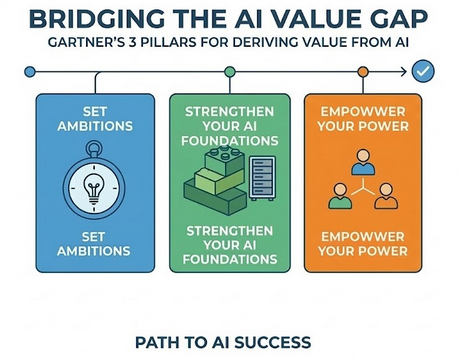
To bridge this gap, Gartner introduced three pillars for deriving value from AI:
- Set clear ambitions: what the analysts called “a return on intelligence”
- Strengthen your AI foundations for “a return on integrity”
- Empower your people to achieve “a return on individuals”
Interestingly, all three pillars pointed to one core requirement: Responsive Governance.
Gartner emphasized that treating data governance as an afterthought is a guaranteed path to failure. Instead, organizations must align governance efforts with clear business outcomes and embed governance directly into operational workstreams.
Balancing Centralized and Distributed Governance
To succeed, D&A leaders should adopt a hybrid operating model. In this approach, organizations keep core governance and critical data initiatives centralized while allowing individual business teams to move quickly and make local decisions.
As a result, enterprises can maintain consistency while still supporting agility and innovation across departments.
Furthermore, Gartner stressed the importance of connecting leadership teams with operational groups and building the right governance skills for every project.
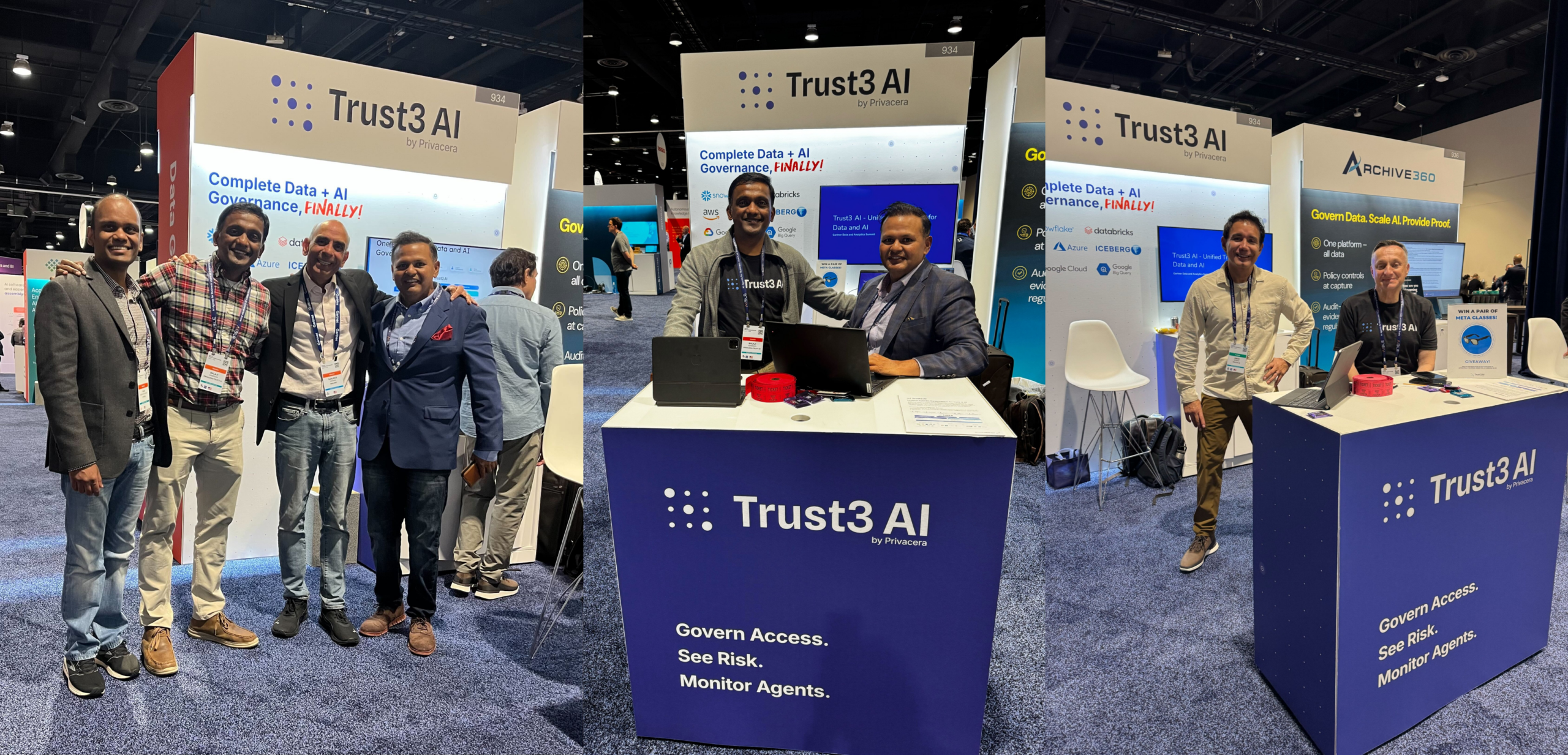
This governance-first message shaped many conversations throughout the summit floor. In particular, it aligned closely with the positioning of the recently rebranded Trust3 AI.
Trust3 AI’s Governance Approach
Trust3 AI stood out as a unified platform that elevates both data and AI governance through its dynamic Trust Layer, which applies policies consistently across multi-cloud ecosystems.
What makes Trust3 AI different is the intelligence built into its Trust Agents. These always-on AI agents automatically discover and classify assets while also enforcing policies in real time.
Consequently, governance shifts from a static control process into a proactive system that scales alongside enterprise AI growth.
Day 2: The GenAI Readiness Mandate
By Tuesday, the conversation shifted heavily toward generative AI readiness and the growing challenge of managing unstructured data.
Preparing enterprise data for generative AI remains a major hurdle for most organizations.
Principal Analyst Nina Showell highlighted this issue, explaining that “almost every GenAI use case requires organizations to extract, qualify and govern significant volumes of unstructured data.”
Why AI-Ready Data Matters
To overcome this challenge, companies must invest heavily in modern data foundations. As a result, Showell predicted a dramatic increase in AI-readiness spending.
Specifically, she explained that spending focused purely on making data AI-ready will increase sevenfold between 2025 and 2029.
This prediction reinforced a growing industry trend: organizations are realizing that successful AI depends on clean, governed, and accessible data.
Cloud Vendors Respond to the Challenge
Major cloud and data vendors used the summit to showcase how they are solving these infrastructure problems.
- AWS demonstrated deep integrations with Amazon Bedrock, helping teams build generative AI applications closer to governed enterprise data.
- Google highlighted Vertex AI and its ability to unify fragmented data pipelines so language models can access data more efficiently.
- Snowflake attracted major attention with updates to its AI Data Cloud and Cortex AI platform. In particular, healthcare organizations showcased how they use Cortex AI to improve patient care and optimize operations.
- Databricks continued promoting its Lakehouse architecture as the ideal foundation for combining analytics, governance, and machine learning workflows.
Collectively, these announcements showed that the industry is rapidly building infrastructure designed specifically for enterprise AI adoption.
Day 3: Context Layers and the Future of Agents
The final day of the Gartner Data Summit focused on future predictions and the rapid rise of autonomous AI agents.
Distinguished VP Analyst Rita Sallam delivered one of the most discussed sessions of the week. She stated, “Through 2027, GenAI and AI agent use will create the first true challenge to mainstream productivity tools in 30 years, prompting a $58 billion market shakeup.”
The Importance of Context Layers
So what do organizations need to ensure secure and reliable AI implementation?
The answer repeated throughout the summit was simple: Context Layers.
Without semantic layers and knowledge graphs, AI agents simply guess what enterprise data means. Consequently, organizations risk inaccurate outputs, hallucinations, and compliance failures.
Anthropic’s Model Context Protocol (MCP) became a major discussion topic during the event. Although MCP offers an open standard for connecting AI systems to external data, analysts repeatedly warned that MCP alone is not enough.
Organizations still need a semantic layer that explains what the data represents and how it should be interpreted.
How Trust3 AI Approaches Context
Trust3 AI reinforced this message throughout the event. The company argued that context should be treated as critical enterprise infrastructure rather than a simple documentation layer.
By building a Unified Trust Layer, which acts as an AI-native metadata and context system, Trust3 AI demonstrated how organizations can avoid rebuilding definitions for every AI project.
More importantly, Trust3 AI showed that when you give AI agents a reliable source of truth, you significantly reduce hallucinations while increasing operational trust.
Three Key Takeaways for Data Leaders
As the summit wrapped up, the direction for enterprise data and AI leaders became increasingly clear. The hype cycle is ending, and organizations are now entering the operational phase of AI adoption.
1. AI Governance is Non-Negotiable
You can no longer separate data governance from AI governance. As autonomous agents gain access to sensitive enterprise systems, governance becomes your primary layer of protection.
Therefore, organizations need platforms that automatically enforce behavioral controls, security rules, and compliance policies.
If governance fails, AI initiatives will fail as well.
2. Context is Critical Infrastructure
Feeding raw enterprise data directly into large language models is extremely risky. AI systems must understand the meaning, relationships, and business context behind enterprise metrics.
As a result, organizations should invest in semantic layers, metadata systems, and context graphs.
Most importantly, context should be treated as living infrastructure that continuously supports AI decision-making.
3. Prepare Your Data for GenAI
The models are ready, but most enterprise data environments are not.
Organizations must break down silos between structured and unstructured data systems. In addition, teams should evaluate whether current pipelines can properly extract, classify, and govern data for generative AI use cases.
Without AI-ready data, even the most advanced models will struggle to deliver reliable outcomes.
What the Gartner Data & Analytics Summit 2026 Means for Trust3 AI Governance
The Gartner Data & Analytics Summit 2026 clearly showed that the future belongs to organizations that govern well and build strong semantic context.
Now is the time for enterprises to evaluate their governance models, strengthen semantic layers, and align AI and data teams under a shared strategy.
Trust3 AI was built specifically for this new reality. By unifying data and AI governance through its Trust Layer, Trust3 helps organizations apply policies consistently, maintain deep business context, and confidently scale AI across modern data platforms.