
TL;DR This post provides a brief overview of Trust3 AI vs. Singulr AI: Data-Layer Enforcement or Boundary Inspection.
- Gartner projects most unauthorized agent activity through 2028 will come from agents overstepping internal policy rather than external attackers, making enforcement at the point of access the priority.
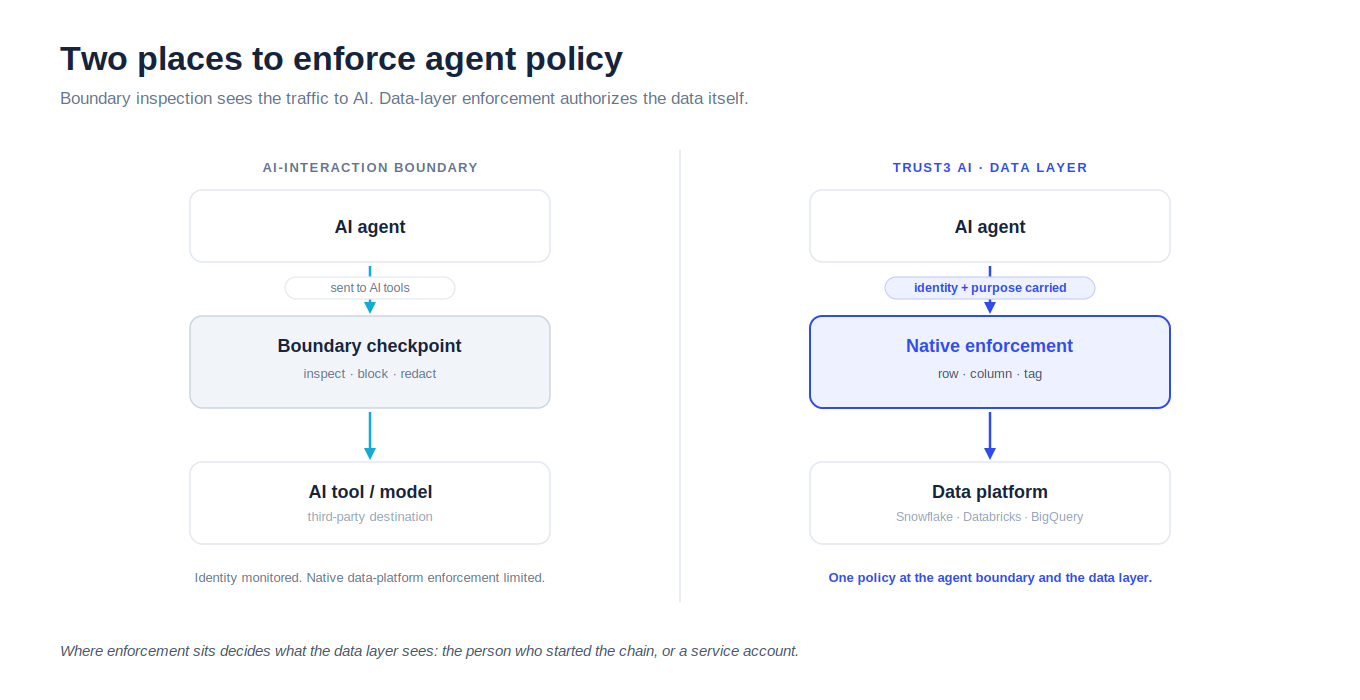
- The two platforms enforce at different layers: Trust3 AI applies row, column, and tag policy natively inside the data platform; Singulr AI inspects and redacts traffic at the AI-interaction boundary.
- Trust3 AI carries the originating user’s identity and declared purpose through every MCP and agent-to-agent hop to the data source, with just-in-time, purpose-based access and zero standing access.
- The two run close on agent discovery, risk scoring, compliance evidence, and SIEM integration.
- Singulr AI centers on continuous CI/CD red-teaming plus endpoint and browser coverage, a fit for governing employee and public AI usage.
- For production agents against regulated data in Snowflake, Databricks, or BigQuery, Trust3 AI enforces where the risk lands: at the data layer, scoped to purpose.
Most enterprises don’t keep a perfect record of agents and their access to data. Agents query databases, call tools, and delegate to other agents faster than security teams can inventory them. Most of that activity stays invisible until an audit surfaces it. The evaluation question has moved past whether to govern agents to which platform enforces control where the risk lands.
Two platforms come up in that evaluation: Trust3 AI and Singulr AI [1]. Both address agent security, but they enforce at different layers, and that decides which one fits a given mandate.
Gartner’s Market Guide for Guardian Agents projects that through 2028, at least 80% of unauthorized AI agent transactions will stem from internal policy violations and misguided agent behavior rather than external attacks. The dominant risk is agents doing what they were never authorized to do. So a platform should be judged first on how well it stops that.
The Architectural Split: Enforce at the Data Layer, or Inspect the Traffic
The clearest difference between the two platforms is where policy is enforced.
Trust3 AI enforces inside the data platform. Row, column, and tag policy runs natively across Snowflake, Databricks, BigQuery, Iceberg, and 50+ native data sources, evaluated at the point of access with no proxy hop. Sensitive fields are masked, encrypted, or tokenized at the source. The agent is authorized against the data it reaches, for the purpose it declared, at the moment it reaches for it.
Singulr AI enforces at the AI-interaction boundary. Its controls inspect prompts, uploads, and responses on the way to AI tools, then block, restrict, or redact PII and PHI before content leaves for a third-party model. That guards against data leaking into unsanctioned tools. It works on the traffic to AI, and native fine-grained enforcement inside the data platform is limited.
For enterprises running production agents against regulated data, data-layer enforcement is the model regulatory guidance is converging on, because it authorizes the data itself rather than the request passing by.
Boundary inspection can catch oversharing. Only data-layer authorization can stop an agent from reaching data without authorization.
Identity Is What Breaks in the Handoff
When an agent reaches data through the Model Context Protocol (MCP, the standard that lets agents connect to tools and data at runtime), or hands work to another agent through agent-to-agent (A2A) delegation, the originating user’s identity tends to dissolve. Three hops in, the data layer sees a service account instead of the person who started the chain. Least privilege becomes impossible, and the audit trail records a robot instead of a user.
Trust3 AI carries the originating user’s identity and declared purpose through every agent hop and every MCP call to the data source, enforcing one policy at both the agent boundary and the data layer in the same decision. Scope narrows down a delegation chain, never expands. That foundation makes purpose-based access real: just-in-time credentials, auto-expiring scopes, and zero standing access, granted per request against the agent’s declared purpose.
Singulr AI applies runtime policy to existing identities and monitors usage for anomalies. Identity continuity through agent hops to the data source is limited, and access runs on standing credentials rather than just-in-time, purpose-scoped grants.
Blocking and Blast Radius: What One Compromised Agent Can Reach
Trust3 AI gates agents at build time on their Trust Score, then enforces runtime guardrails and a hard kill switch through AI Gateway plugins for the major agent runtimes. Every action leaves a signed, tamper-evident record. When a violation occurs, blast-radius mapping shows how far it spreads: it propagates to every connected agent within a set number of hops, with identity-to-data reachability traced across agents, MCP servers, and sources.
Singulr AI’s Runtime Control blocks known attack patterns and restricts data access at the point of use, and maps agentic dependencies across the lifecycle. Identity-to-data blast-radius across delegation chains is limited.
Where the Two Platforms Run Close

Both discover agents. Trust3 AI auto-discovers across Bedrock, Copilot Studio, Databricks, LangChain, and custom frameworks, flagging unregistered agents as they appear; Singulr AI discovers AI in use across homegrown apps, public services, and SaaS copilots, including browser extensions. Trust3 AI centers on the agent pipeline and the data it touches; Singulr AI casts wider across public and employee-facing AI.
Both score agent risk: the Trust3 AI Trust Score is live, continuously recalculated, and explainable across four weighted dimensions; Singulr Pulse scoring is available, prioritized by severity.
Both support audit readiness. Trust3 AI generates one-click evidence packs for the EU AI Act, HIPAA, and NIST AI RMF, with end-to-end tracing in an immutable log. Singulr AI produces tamper-evident records, feeds SIEM and EDR, and supports board-level reporting, with SOC 2 and ISO 27001.
Both integrate with the existing stack rather than replacing it. Trust3 AI connects to Entra, SIEM, and workflow tools to drive enforcement; Singulr AI correlates signals the SIEM and EDR already collect.
Where Singulr AI Focuses
Two areas fall outside the Trust3 AI mandate by design, and Singulr AI covers them. It runs continuous red-teaming built into CI/CD, mapped to the OWASP LLM Top 10, NIST, and MITRE ATLAS, which has clear value for teams building agents from scratch. Endpoint and browser coverage is available, spanning desktop AI apps and browser extensions for everyday employee AI use.
Trust3 AI does not govern employee endpoints or browser activity. That boundary is deliberate: it governs the build-to-runtime agent pipeline and the data behind it, while endpoint productivity governance is a separate, CIO-led mandate.
Trust3 AI vs. Singulr AI: How the Two Platforms Compare
| Criteria | Trust3 AI | Singulr AI |
| Data-layer enforcement | Enforces natively inside the data platform: row, column, and tag access control at the point of access, with masking, encryption, and tokenization | Enforces at the AI-interaction boundary; blocks, restricts, and redacts PII and PHI in prompts, uploads, and responses; limited native data-platform enforcement |
| Identity and least-privilege access | Purpose-based access per request; just-in-time credentials, auto-expiring scopes, zero standing access | Runtime policy on existing identities; limited to standing credentials, without just-in-time or purpose-scoped grants |
| Identity through delegation | Carries authorization context through every agent-to-agent hop to the data source; scope narrows, never expands | Monitors agent usage for anomalies; limited identity continuity across agent hops |
| Build and runtime blocking / kill switch | Build-time gating on Trust Score, plus runtime guardrails and a hard kill switch via AI Gateway plugins | Runtime Control blocks attack patterns and restricts data access at the point of use |
| Cross-asset blast-radius / lineage | Violation propagates to every connected agent within N hops; identity-to-data reachability across agents, MCP servers, and sources | Maps agentic dependencies and tracks risk records; limited identity-to-data reachability |
| Data-platform depth | Native across Snowflake, Databricks, BigQuery, Iceberg, and 50+ native data sources | Boundary-level inspection, platform-agnostic |
| Agent discovery and shadow AI detection | Auto-discovers agents across Bedrock, Copilot Studio, Databricks, LangChain, and custom frameworks; flags unregistered agents on first appearance | Discovers AI in use across homegrown apps, agents, public AI services, and SaaS copilots, including browser extensions |
| MCP and A2A protocol security | MCP inventory and visibility; scoped credentials that carry authorization through A2A delegation chains; native to the Trust Layer | Adversarial testing of tool and agent surfaces; limited protocol-level MCP and A2A controls |
| Risk and posture scoring | Trust Score, X.X out of 10, live, continuously recalculated, and explainable across four weighted dimensions | Singulr Pulse risk score available, prioritized by severity |
| Compliance evidence and audit trail | One-click evidence packs for EU AI Act, HIPAA, and NIST AI RMF; end-to-end tracing in an immutable log | Tamper-evident records, SIEM and EDR feeds, board-level reporting; SOC 2 and ISO 27001 |
| Anomaly and threat detection | Scope-drift detection via LLM classifier; real-time PII-leakage and token-usage anomaly detection | Continuous red-teaming in CI/CD, mapped to OWASP, NIST, and MITRE |
| Endpoint / browser coverage | Out of scope by design; governs the build-to-runtime agent pipeline and the data behind it | Endpoint and browser coverage available: desktop AI apps and browser extensions |
| Integration with existing security stack | Integrates with Entra, SIEM, and workflow tools to drive enforcement | Correlates existing SIEM and EDR signals |
Questions to Ask Before You Choose
- When your agents reach Snowflake or Databricks, whose identity is on the query: the person who started the chain, or a service account?
- Can you scope an agent’s access to a single declared purpose and have it expire when the task ends, or does it hold standing credentials?
- When one agent is compromised, can you see every other agent, tool, and data source it can reach?
- Is your primary mandate governing production agents against regulated data, or governing how employees use AI on their endpoints?
The Bottom Line
Both platforms address real agent security requirements. Singulr AI covers continuous red-teaming, endpoint and browser usage, and broad discovery across public and SaaS AI, which fits organizations whose main concern is how their workforce uses AI. As a newer entrant that reached general availability in early 2025, its depth per capability has had less time to be tested in the market.
Trust3 AI is built for a different mandate: an agent security control plane that governs the build-to-runtime pipeline and the data behind it. Its advantages concentrate where the dominant enterprise risk lives. Purpose-based access with zero standing access, fine-grained enforcement native to the data layer across Snowflake, Databricks, BigQuery, and 50+ sources, identity carried through every agent hop to the data source, blast-radius mapping across connected agents, and one-click compliance evidence, all built on the production policy-enforcement lineage of the team that created Apache Ranger.
Gartner’s projection is the deciding lens. If most unauthorized agent activity through 2028 will come from agents overstepping internal policy rather than outside attackers, then the platform that authorizes at the data layer, scopes every grant to a declared purpose, and removes standing access is built for the risk enterprises will actually face.
Your agents are already running, reaching data, calling tools, and delegating to each other. The evaluation comes down to one thing: whether your platform enforces at the point where the risk lands.
Let’s chat further here: https://trust3.ai/demo/
Related Articles