Generative AI and autonomous agents are becoming part of everyday enterprise workflows. As these systems gain access to sensitive data, invoke tools, and delegate tasks, organizations need practical ways to identify risks, monitor activity, and enforce appropriate controls.
Trust3 AI helps enterprises put responsible AI principles into practice through agent discovery, observability, security, and data access control. These capabilities support activities within the National Institute of Standards and Technology’s AI Risk Management Framework (NIST AI RMF), connecting risk management objectives with operational visibility and enforcement.
Key Takeaways
- Discover and map: Identify agents across connected environments and understand their ownership, identities, and access.
- Observe and measure: Trace agent activity, investigate policy decisions, and monitor changes in behavior.
- Secure and manage: Enforce authorization, apply runtime guardrails, and respond to policy violations.
- Support governance: Connect policies, ownership, and audit evidence across agent and data interactions.
Together, these capabilities help organizations make responsible AI an ongoing operational practice.
Why Responsible AI Matters More Than Ever
AI systems introduce risks that extend beyond traditional application security.
An agent may retrieve sensitive information, select a tool, call an external service, or pass work to another agent. Its behavior can change as models, prompts, permissions, and connected tools change.
Organizations must address risks such as:
- Unauthorized access to sensitive data.
- Exposure of personal or confidential information.
- Prompt injection through retrieved content or tools.
- Excessive permissions and unintended actions.
- Loss of accountability across delegated workflows.
Responsible AI also requires organizations to evaluate issues such as fairness, reliability, and societal impact. Security controls and activity records provide an important foundation within that broader effort.
The NIST AI RMF organizes AI risk management around four core functions:
- Govern: Establish organizational policies, responsibilities, and a culture of risk management.
- Map: Understand the system’s context and identify relevant risks.
- Measure: Assess, analyze, and track identified risks.
- Manage: Prioritize risks and take action to address them.
Govern is a cross-cutting function that informs the other three. Risk management continues throughout the AI lifecycle.
How Trust3 AI Supports Responsible AI
Trust3 AI’s Discover, Observe, Secure approach helps teams connect these framework objectives with the agents and data in their environments.
Agent Discovery: Map Your AI Landscape
Understanding AI risk starts with knowing which systems exist and how they connect to enterprise resources.
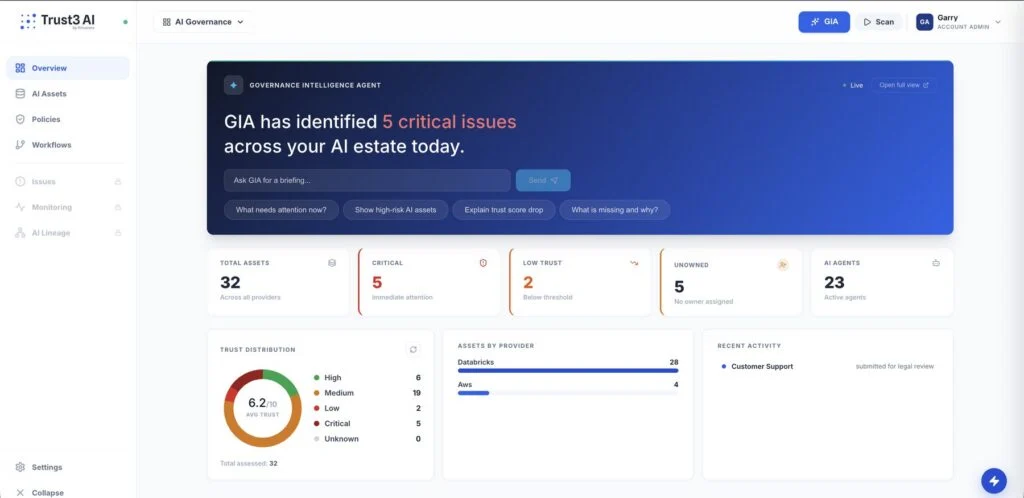
Trust3 AI discovers agents across connected platforms using signals from platform APIs, audit trails, SDK activity, and other supported sources. Its inventory provides context about ownership, operating identity, accessible resources, and security posture.
This helps teams identify unregistered agents, investigate ownership gaps, and understand where permissions may exceed an agent’s intended purpose.
Within a NIST-aligned program, this information supports Map activities by providing technical context for identifying and assessing risk.
Agent Observability: Measure and Monitor Activity
An inventory establishes what exists. Observability helps teams understand what those systems actually do.
Trust3 AI captures prompts, tool calls, responses, data access events, and agent-to-agent handoffs across connected workflows. Identity context and recorded policy decisions help teams investigate activity and reconstruct captured execution paths.
Behavioral monitoring can also surface changes, including new tools, data sources, and delegation patterns.
These capabilities support Measure activities by providing evidence for assessing security behavior, tracking policy adherence, and investigating deviations. They also inform decisions about where additional evaluation or controls are needed.
Agent Security and Data Authorization: Manage Identified Risks
Once risks are identified, organizations need controls that act at the point of execution.
Trust3 AI evaluates requests using identity, declared purpose, and resource classification. Runtime controls can block policy violations, restrict sensitive data exposure, and apply time-bounded authorization for approved actions.
For MCP connections, Trust3 AI provides server verification, tool scoping, content inspection, and credential isolation. For agent-to-agent interactions, it verifies identities, bounds delegated scope, and records handoffs.
At the data layer, Trust3 AI supports attribute-based, tag-based, and role-based access controls across supported integrations, including Snowflake, Databricks, BigQuery, and S3. Centralized policies and native enforcement help apply access restrictions to humans, applications, and agents.
These capabilities support Manage activities by turning risk decisions into enforceable controls and traceable responses.
Policies, Ownership, and Evidence: Support Governance
Responsible AI requires clear accountability for systems, policies, and remediation.
Trust3 AI provides agent ownership context, access policies, activity records, and structured violation workflows. Teams can connect an issue to evidence, assign responsibility, and track remediation.
These capabilities support Govern activities by helping organizations operationalize policies and maintain evidence for oversight. Organizational leadership remains responsible for defining acceptable use, risk tolerance, and review processes.
Putting the NIST Framework into Practice
The NIST AI RMF gives organizations a structure for managing AI risk. Trust3 AI provides technical capabilities that support that work: discovering agents, observing activity, enforcing access boundaries, and recording evidence.
This is a practical capability mapping, rather than a claim that deploying Trust3 AI alone fulfills the entire framework. Responsible AI also depends on organizational processes, use-case evaluation, and human oversight.
By connecting those practices with operational controls, enterprises can adopt AI with clearer accountability and greater control over how agents interact with data, tools, and other systems.
About Trust3 AI
Trust3 AI provides a control plane for AI agent security and data access. Its platform brings together agent discovery, observability, runtime security, MCP security, agent-to-agent security, and fine-grained data authorization.
Our mission is to help enterprises accelerate AI adoption while maintaining control over agent actions and data interactions.
Secure Every Agent Action. Protect Every Data Interaction.
Explore Trust3 AI to learn how these capabilities can support your responsible AI program.
Related Articles