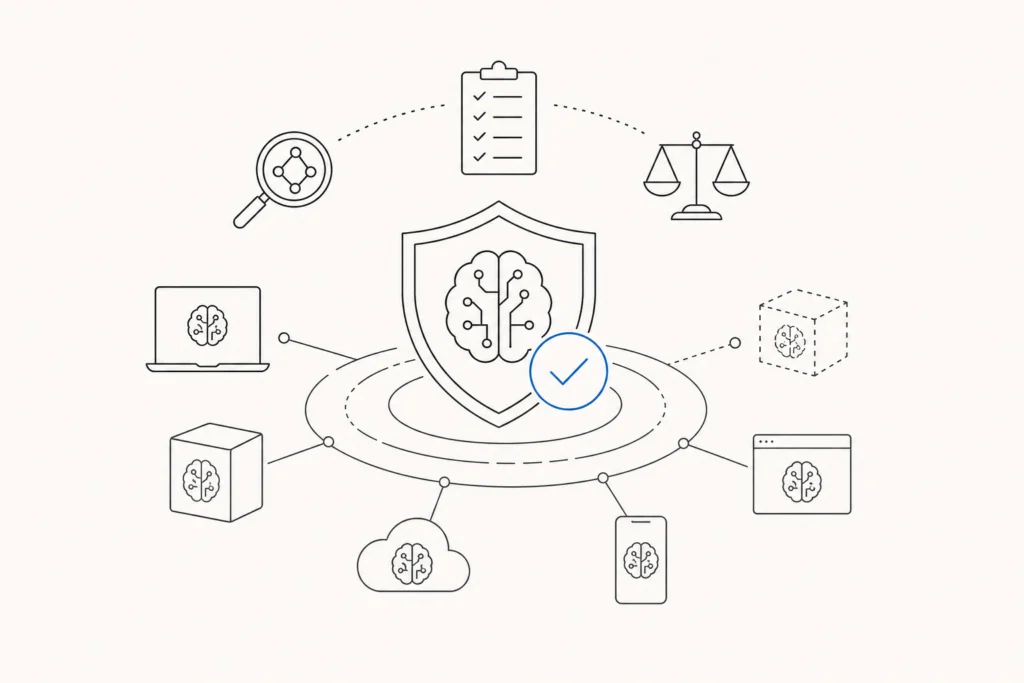
To ensure compliance across all AI deployments, first inventory every AI system, including shadow tools. Then map risks against a framework such as NIST AI RMF, set your risk appetite, assign ownership, and enforce technical controls with continuous monitoring. Compliance only holds when you can show evidence of what each system did.
Most organizations already use AI widely, but few have formal governance in place. One analysis from Evolvance Market Research found that over 83% of organizations use AI tools, yet only 25% have established a formal governance framework. Unapproved tools and a fast-moving regulatory picture raise the stakes further. This guide walks through the steps in the order a team does them.
What does it mean to ensure compliance across AI deployments?
Ensuring compliance across AI deployments means proving that every AI system your organization runs meets the laws, standards, and internal policies that apply to it. The key word is "proving." A policy on paper does not show what a system actually did.
Two terms often get blended together. In this guide, AI governance means your internal system of rules, roles, and decision rights for how AI is built, bought, and used. AI compliance means the outcome you must demonstrate to regulators, auditors, and customers: that your systems follow the rules that bind you. Governance is how you run things. Compliance is the evidence that you did.
AI makes both harder than traditional software. A conventional application behaves the same way each time, so you can test it once and document the result. AI systems can give different outputs from the same input, change when models are updated, and, in the case of autonomous agents, call tools and reach data without a person approving each step. Rules keep multiplying too. During 2025, U.S. states introduced more than 1,000 distinct measures related to AI regulation, according to unite.ai. A one-time review cannot keep pace.
Why is AI non-compliance so costly?
Non-compliance costs you from several directions at once: fines and legal fees on one side, lost trust, leaked data, and rework on the other. Some costs are easy to count. Others only show up after an incident.
For scale, CYPHER's 2024 report puts the average annual cost of noncompliance for businesses at $1.6 million. That figure covers businesses in general, not AI incidents specifically, so treat it as a baseline for what regulatory failure costs, not a forecast for your AI program. The pressure behind it is real: with more than 1,000 state-level AI measures introduced in 2025, the list of rules you may be held to keeps growing.
| Type of cost | Examples | How it shows up |
|---|---|---|
| Direct | Regulatory fines, legal fees, mandated audits | Invoices and penalty notices you can budget against |
| Direct | Remediation and system shutdowns | Engineering time spent fixing or pulling a system |
| Indirect | Data leakage through unapproved tools | Sensitive data exposed with no record of where it went |
| Indirect | Lost customer and partner trust | Stalled deals, failed security reviews |
| Indirect | Slower AI adoption | Teams freeze projects because nobody can sign off |
The indirect costs often worry teams more, because they are harder to see coming. One employee pasting customer records into an unapproved chatbot can create a data exposure that no policy document will undo.
Step 1: Inventory every AI system, including shadow AI
You cannot govern what you cannot see, so start with a full inventory of all AI systems and shadow assets. Include tools your organization approved, tools teams bought on their own, AI features built into software you already license, and agents your developers have deployed.
Shadow AI is the part most teams underestimate. Data from Volkov Law Group indicates that more than 80% of employees use unapproved AI tools in the workplace. Treat that as one analysis, not a universal rate, but plan as if your organization has the same problem. Combined with the gap between AI use and formal governance (over 83% of organizations use AI tools, yet only 25% have a formal framework), it suggests your official list is probably incomplete.
Build the inventory in this order:
- Start with what you know. List every sanctioned AI tool, model, and agent, and name an owner for each.
- Survey the business. Ask each department head which AI tools their teams use, including free and personal accounts.
- Check technical sources. Review network logs, single sign-on records, expense reports, and API usage for AI services nobody reported.
- Look inside existing software. Note AI features that vendors switched on in tools you already pay for.
- Record the essentials for each system: purpose, owner, data it touches, whether it acts autonomously, and which vendors or models sit underneath.
- Sort every system into a risk tier. A system that handles regulated or sensitive data, or takes actions without review, belongs in a higher tier than one that drafts internal notes.
Keep the inventory current. A spreadsheet updated once a year will be wrong within weeks, so assign someone to own it and set a regular review.
Step 2: Choose a framework and check your existing policies
Pick a recognized framework to give your program structure, then test whether your existing policies cover AI. Most organizations do not need to write governance from scratch. They need to find where current rules fall short.
Two frameworks come up most often. The NIST AI Risk Management Framework organizes the work into four functions: Govern, Map, Measure, and Manage. It is voluntary and non-certifiable, so no one will audit you against it, but it gives your team a shared vocabulary and a defensible structure. Version 1.0 includes 72 subcategories that define specific outcomes for managing AI risk. Applying them to your own use cases takes organizational judgment, so expect to select and adapt, not adopt wholesale. ISO/IEC 42001 is the other common choice, an international standard for AI management systems. Teams that want something auditable often look at it alongside NIST.
Then run a policy check. Pull your data protection, acceptable use, vendor risk, security, and incident response policies, and ask three questions of each:
- Does it mention AI, models, or automated decisions at all?
- Does it assume a human approves every action? Agents break that assumption.
- Can you produce evidence that people follow it?
Policies that fail these questions are your first gaps. Write them down, because Step 3 builds on them. A sound practice is to keep a short list of gaps, each with an owner and a due date.
Step 3: Map risks, set risk appetite, and add sector-specific rules
With your inventory and framework in hand, map the specific risks each AI system creates, then decide how much risk your organization will accept. This is where general principles turn into decisions you can defend.
Work through it in this order:
- Map risks per system. For each entry in your inventory, note what could go wrong: leaked data, biased or wrong outputs, unauthorized actions, vendor outages, or a model change that breaks behavior. The Map function in NIST AI RMF is built for this.
- Set your organizational context and risk appetite. Decide what you will accept, what needs approval, and what is off limits. A customer-facing agent that can issue refunds should face a stricter bar than an internal summarizer.
- Layer in sector-specific rules. Healthcare is a clear example. If AI touches protected health information, HIPAA obligations apply, and that data must stay protected when a model or agent handles it. Financial services, education, and public-sector teams face their own rules. Ask legal counsel which apply, because the regulatory picture keeps shifting and new requirements can reach systems you already run.
- Record the gaps. Compare required controls against what exists today.
Here is a worked example. Suppose a clinic uses an AI scribe that drafts visit notes. Mapping shows it processes protected health information, runs on a vendor's model, and stores transcripts. The gap analysis finds no vendor agreement covering the AI feature, no limits on who can read transcripts, and no logging. Each gap gets an owner and a deadline, and the scribe stays in a high-risk tier until they close.
Step 4: Enforce technical controls and monitor autonomous agents
Policies only hold if technical controls enforce them, so this step is where you put controls and monitoring into practice. It matters most for autonomous agents, which act on their own and can reach data and tools without a person approving each move.
Build the technical layer in four parts:
- Discover continuously. Your Step 1 inventory goes stale fast, so automate discovery of new agents, models, and AI connections as they appear. This is also your main control against shadow AI. Combine it with network and identity monitoring so unapproved tools surface quickly, and give people an approved alternative so they have less reason to go around you.
- Log what agents do. Capture every prompt, tool call, and decision, with timestamps and the identity behind each. These logs become the evidence auditors ask for, which is the difference between claiming compliance and proving it.
- Control access by purpose. Give each agent only the data and tools its job requires, and tie permissions to a stated purpose. An agent built to answer billing questions should not be able to read HR files, even if it technically could.
- Monitor at runtime. Watch for agents drifting outside their purpose, unusual tool use, and attempts to reach restricted data, and set alerts and kill switches for the highest-risk systems. Cover the full attack surface: MCP servers, agent-to-agent communication, APIs, and the underlying data sources.
A dedicated agent security platform can handle much of this at scale. Trust3 AI is an agent security platform that helps enterprises discover, monitor, and control AI agents. Trust3 AI's agent security platform discovers agents across your environment, observes their prompts, tool calls, and decisions, and enforces purpose-based access controls from build time through runtime. It is vendor-neutral and works across clouds and agentic frameworks. Pricing is not publicly available and requires contacting the sales team. No tool guarantees compliance, though. It supports evidence and enforcement, while accountability stays with your organization.
How do you maintain compliance as AI and regulations change?
You maintain compliance by treating it as a recurring cycle with named owners, not a project that ends at launch. Models get updated, agents gain new tools, and rules keep shifting, so the evidence you gathered last quarter goes stale. A fixed review rhythm keeps it fresh.
Use this checklist to set that rhythm:
- Monthly: Reconcile your inventory against discovery results. Review new agents, new data connections, and any unapproved tools that surfaced.
- Quarterly: Re-tier systems whose purpose, data, or autonomy changed. Review access permissions and close open gaps from your gap analysis.
- After every major change: Re-assess a system when you swap its model, add a tool, or widen its data access.
- Twice a year: Check for new or amended rules with legal counsel. Rules shift often, so assume something relevant changed. Revisit your policies against the framework you chose.
- Always: Keep logs and approvals retrievable, and test that you can answer an auditor's question about any system within a day.
Most teams skip scheduled reviews, so a team that keeps to this rhythm is already ahead. Trust3 AI supports this cycle by keeping discovery and logging running between reviews, though your team still owns the decisions.
Prices and plan limits verified as of November 2026.
FAQs
What is the difference between AI governance and AI compliance?
The two terms overlap but are not the same. Governance covers the rules, roles, and decisions behind how you run AI responsibly. Compliance is the proof that your systems meet the laws, standards, and policies that apply to them. Governance is how you run AI responsibly. Compliance is the evidence you can show regulators, auditors, and customers that you did.
What does HIPAA compliance mean for AI systems that touch patient data?
In general terms, it means protected health information must stay protected when an AI tool or agent handles it. Any vendor processing that data needs appropriate agreements, access should be limited to what the task requires, and activity should be logged. Ask legal counsel which specific HIPAA obligations apply to each AI system you run.
How do you maintain compliance with regulatory requirements as AI rules change?
Set a recurring review cycle. Reconcile your AI inventory regularly, re-tier systems when their purpose or data changes, and check for new rules with legal counsel on a fixed schedule. Keep logs and approvals easy to retrieve so you can show evidence on request. Assign a named owner to each system so reviews actually happen.
What are the best practices for AI risk management?
Start with a complete inventory, including shadow AI. Choose a framework such as NIST AI RMF, map risks for each system, and set a clear risk appetite. Then enforce controls technically, with logging, purpose-based access, and runtime monitoring for agents. Review on a schedule, and keep a record of gaps with owners and deadlines.
What does ensuring compliance actually mean in practice?
In practice, it means you can answer three questions for any AI system: what it is, what rules apply to it, and what it actually did. You know each system exists, you have decided how much risk is acceptable, and you hold logs showing the system stayed within its limits. Paper policies alone do not meet that bar.
Who should own AI compliance inside an enterprise?
Accountability should sit with a named senior owner, often in security, risk, or legal, with each AI system also assigned its own business owner. Compliance works best as a shared effort among security, legal, data, and engineering teams. No single tool or department can carry it alone, and software never replaces your organization's accountability.
Conclusion
To ensure compliance across your AI deployments, you need to know what you run, decide what risk you will accept, and keep proof of what each system does. Policies matter, but evidence from logs and enforced access controls is what holds up under review, especially for autonomous agents.
Start by checking whether your current AI inventory matches what employees actually use. Then pick one framework, name an owner for each system, and put your first monthly review on the calendar.
Related Articles