The Next Wave of Data & AI: Insights from Gartner Data & Analytics Summit 2026

by Ibby Rahmani
Last updated on March 17, 2026
The conversation around data and artificial intelligence has officially shifted. We are no longer just marveling at the novelty of generative AI. Instead, we are asking hard questions about how to control it, scale it, and make it understand our businesses.
The Gartner Data & Analytics Summit 2026 in Orlando, Florida, made this transition incredibly clear. Thousands of data leaders gathered to untangle the complexities of AI governance, semantic context layers, and organizational readiness.

The overarching theme of the week was undeniable:
If your data lacks deep business context and proper governance, your AI initiatives will inevitably fail.
Over three action-packed days, analysts, and industry giants mapped out the future of enterprise data. We saw massive announcements and strategic shifts from major players, highlighting a collective race to build robust infrastructure for autonomous agents.
Here is a detailed look at the defining moments of the 2026 Gartner Data and Analytics Summit and what they mean for your data strategy.
Day 1: Laying the Foundations for AI Value
The Gartner Data Summit kicked off with a sobering reality check. Analysts Adam Ronthal and Georgia O’Callaghan took the main stage to discuss the widening gap between AI ambition and actual value realization.
As Ronthal observed, “Success isn’t always about being the fastest, but about finding your own path to value, while managing risk and cost.”
While excitement around AI is at an all-time high, few see a measurable return on investment.
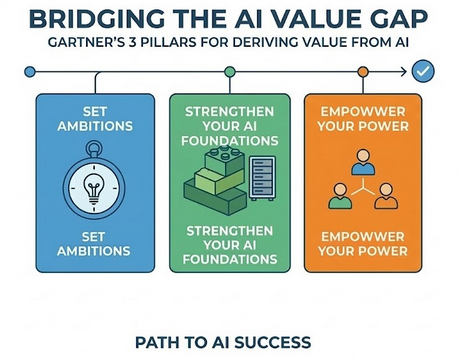
To bridge this gap, Gartner introduced three pillars for deriving value from AI:
- Set clear ambitions: what the analysts called “a return on intelligence”
- Strengthen your AI foundations for “a return on integrity”
- Empower your people to achieve “a return on individuals.”
Guess what? This all pointed to one underlying need: Responsive Governance.
Gartner emphasized that treating data governance as an afterthought is a guaranteed path to failure. To overcome persistent governance challenges, data and AI leaders should align efforts with clear business outcomes and embed governance activities directly into business workstreams.
To succeed, D&A leaders should adopt a hybrid approach, where they keep their most important data work organized at the center, but let individual teams move fast and make their own decisions when needed. When you connect your teams from the top level down to local groups and focus on building the right skills for each project, you get both steady results and the flexibility to handle whatever comes next.
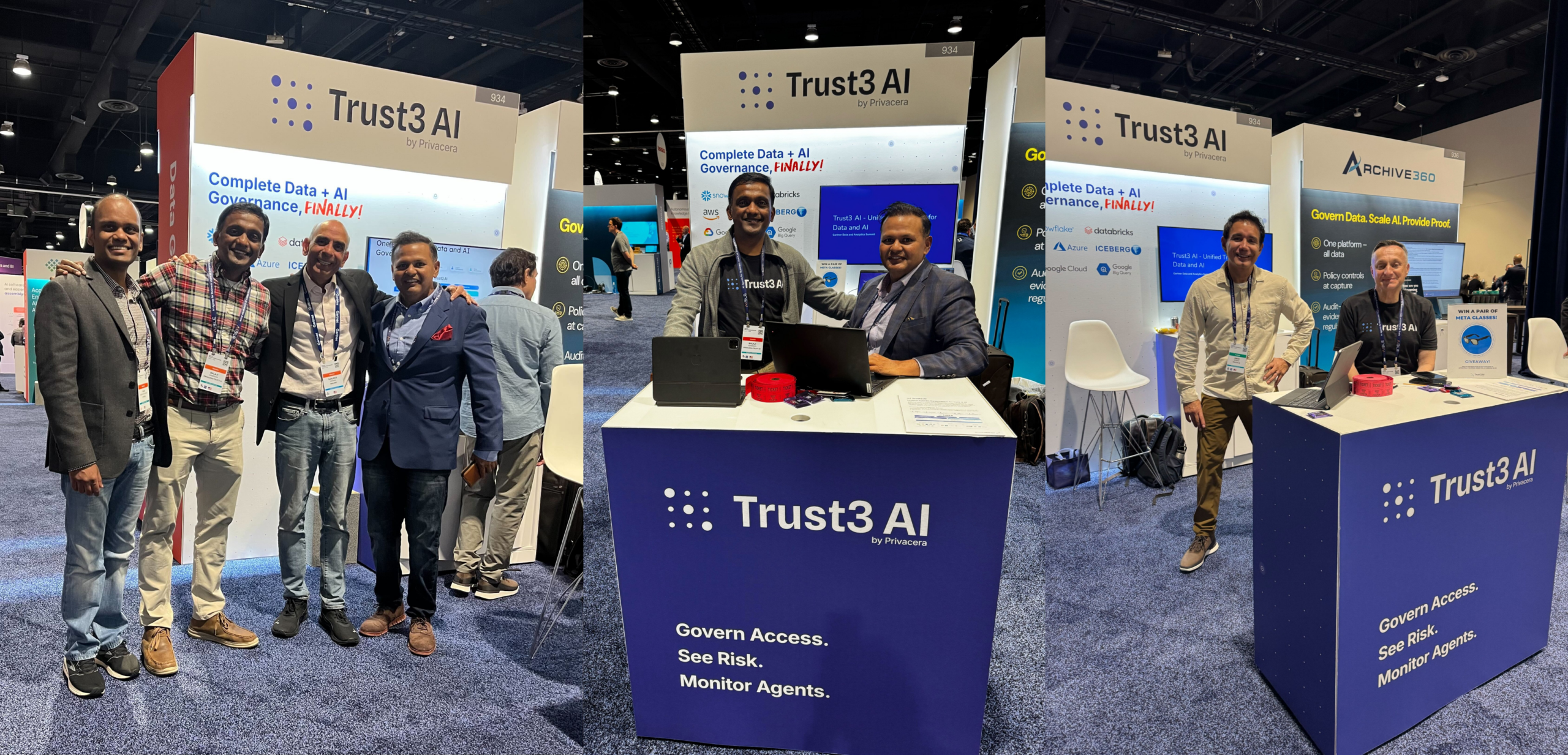
This focus on governance perfectly framed the conversations happening on the expo floor, and nowhere more so than at the recently rebranded Trust3 AI.
Trust3 AI stood out as a unified platform that elevates both data and AI governance through its dynamic Trust Layer, which seamlessly applies policies and standards across multi-cloud ecosystems. What sets Trust3 AI apart is the proactive intelligence embedded in its Trust Agents: these always-on, AI-driven teammates not only automate the discovery and classification of assets but also enforce policies in real time. As a result, governance shifts from a static control function to an agile engine that empowers organizations to stay ahead of rapid AI expansion while maintaining control and trust at every layer.
Day 2: The GenAI Readiness Mandate
By Tuesday, the conversation shifted heavily toward generative AI readiness and the massive hurdle of unstructured data. Preparing data for generative AI remains a major hurdle for many organizations.
Principal Analyst Nina Showell highlighted this challenge, noting that “almost every GenAI use case requires organizations to extract, qualify and govern significant volumes of unstructured data.”
To overcome this obstacle, companies must invest heavily in their foundational data infrastructure. As a result, Showell predicted a massive spike in spending “purely to make data AI-ready, as the share of AI spending on data readiness will increase sevenfold from 2025 through 2029.”
Major cloud and data vendors stepped up to address these infrastructure demands.
- AWS showcased deep integrations with Amazon Bedrock, helping teams build generative AI applications closer to their governed data.
- Google followed suit, highlighting how Vertex AI is unifying fragmented data pipelines to feed hungry language models more efficiently.
- Snowflake drew massive crowds at their booth and breakout sessions as they unveiled updates to their AI Data Cloud. They showcased Cortex AI, demonstrating how healthcare organizations are using it to optimize operations and improve patient care.
- Databricks was also a major presence, continuing to push their Lakehouse vision as the ultimate architecture for combining traditional analytics with advanced machine learning workflows.
Day 3: Context Layers and the Future of Agents
The final day of the Gartner Data Summit looked toward the horizon, focusing on 2026 predictions and the rise of autonomous AI agents.
Distinguished VP Analyst Rita Sallam delivered a powerhouse session, stating, “Through 2027, GenAI and AI agent use will create the first true challenge to mainstream productivity tools in 30 years, prompting a $58 billion market shakeup.”
So what do you need to ensure efficient and secure AI implementation?
You need “Context Layer.”
Without semantic layers and knowledge graphs, AI agents simply guess what your data means. Anthropic’s Model Context Protocol (MCP) was a frequent topic of discussion. While MCP offers an open standard for connecting AI to external data, analysts warned that MCP alone is not enough. You still need a consistent semantic layer to tell the AI what the data represents.
Trust3 AI hammered this point home throughout the event. They argued that context must be treated as critical enterprise infrastructure, not just a documentation exercise. By building a Unified Trust Layer, which is basically an AI-native metadata and context layer, Trust3 AI demonstrated how organizations can stop rebuilding definitions for every new AI project. They showed that when you give AI agents a reliable source of truth, you eliminate hallucinations and build operational trust.
Three Key Takeaways for Data Leaders
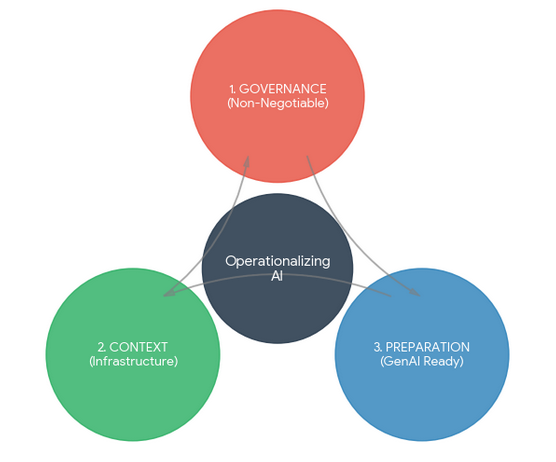
As the summit wrapped up, the path forward for data and analytics leaders became abundantly clear. The hype phase is over, and the hard work of operationalizing AI has begun. Here are the three main takeaways you need to bring back to your team.
1. AI Governance is Non-Negotiable
You can no longer separate data governance from AI governance. As autonomous agents begin accessing your sensitive information, governance becomes your primary line of defense. You need platforms that enforce behavioral controls and compliance policies automatically. If your governance fails, your AI will fail.
2. Context is Critical Infrastructure
Dumping raw data into a large language model is a recipe for disaster. Your AI needs to understand the “how” and “why” behind your business metrics. You must invest in unified semantic layers and context graphs. Treat context as a living, breathing infrastructure that feeds your AI agents exactly what they need to make accurate decisions.
3. Prepare Your Data for GenAI
The models are ready, but your data probably is not. You need to break down the silos between structured and unstructured data management. Audit your current data pipelines and ensure you have the right mechanisms to extract, qualify, and govern data specifically for generative AI use cases.
What the Gartner Data & Analytics Summit 2026 Means for Trust3 AI Governance
The Gartner Data & Analytics Summit 2026 proved that the future belongs to those who govern well and build deep context. It is time to roll up your sleeves and get your data house in order. Evaluate your current semantic layers, bring your governance and AI teams to the same table, and start building the foundation your autonomous agents will need to thrive.
Trust3 AI was built for this new reality. By unifying data and AI governance through its Trust Layer, Trust3 helps organizations apply policies consistently, maintain deep context, and confidently scale AI across modern data platforms.
Explore how Trust3 AI helps organizations operationalize AI governance and build trusted data foundations. If you’re ready to move beyond experimentation and into production-scale AI, you can also schedule a demo to see how Trust3 supports secure, enterprise-ready AI deployments.