Every company needs to create and keep new customers. To do this, they need to solve a customer’s problems rather than create cool product features. CIOs understand that they do not buy products. Instead, they buy solutions to solve their problems. Given this, what is the value of data security governance? Let’s start by reviewing real customer use cases and case studies.
Drivers for Data Security Governance
Without question, the cloud and how it makes data more pervasive is the major driver behind customers purchasing a data security governance solution. The following needs drive Privacera customers to the cloud:
- Growing business with market-leading capabilities
- Leveraging cloud to deliver personalized journeys
- Innovating application of data
Many customers also need to create true information democracy. At the same time, they need to prevent adverse outcomes, comply with data security, prove adherence, secure data consistently, establish effective governance, and speed up access. Here are some examples:
- Retail Manufacturer: For our global retail customer, the amount of data they processed had accelerated over the last several years. A big-data environment in AWS had been put in place, using cloud services vendors Snowflake and Databricks. However, the process for onboarding new datasets and users took weeks and heavily relied on scarce IT resources.There had to be a better answer.
- Healthcare Payer and Insurer: Our Fortune 500 insurer customer needed a way to securely migrate its data and protect that sensitive data once it was in the cloud. This included creating a centralized view of all sensitive data and the ability to apply fine-grained access controls.
- Telecommunications Provider: This customer collects vast amounts of data from its customers. The company’s big-data initiative aimed to make use of this data to improve its customer experience, marketing, and operations. The customer needed a means to ensure it could govern this data effectively, including fine-grained access controls.
- Media and Entertainment Company: This customer collects large amounts of consumer data for their businesses. Their predictive analytics team uses this data to run analytics on trends and optimize customer experience. However, this customer also needed a strong data governance layer with fine-grained access control in order to comply with its privacy policies, information records policies, GDPR, and CCPA.
- Financial Services Company: As a leading financial institution, this customer needs to comply with Gramm-Leach-Bliley Act (GLBA), with GLBA rules limiting the disclosure of nonpublic information about consumers to nonaffiliated third parties. Unfortunately, this customer had no consistent way to identify, tag, protect, or monitor sensitive information across all of its systems. This created gaps in security and access coverage which was discovered during an audit.
Data Security Governance Value Achieved
By understanding the above customer problems, the next question is what did customers achieve with Data Security Governance? Customers actually accelerated their cloud migrations without compromising security or access. In some cases, customers even reduced or slowed their data set proliferation while making data more accessible. And most importantly, customers onboarded data and users faster. The following describes specifics on the value propositions customers found from implementing comprehensive data security governance.
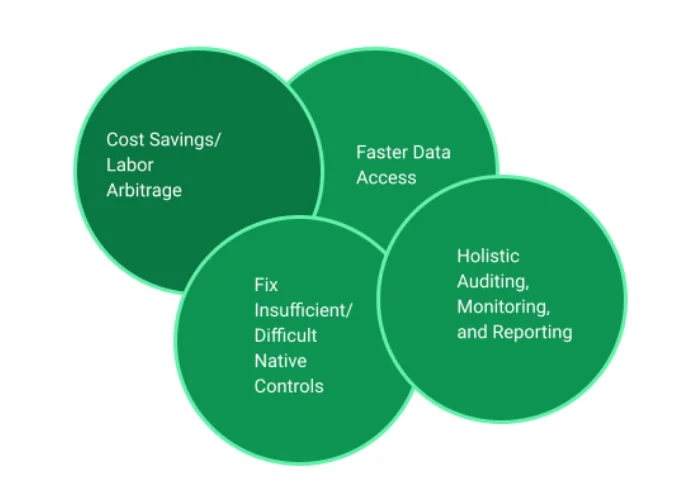
There are four primary value propositions. Labor savings comes from the management of data security across an increasingly complex data estate but also comes from simplifying the process by which customers get access to data. Parallel to this is faster access to data. Interestingly, what we describe here resides on the data defense side of things.
And the second two bubbles deal with how controls are implemented and measured. It is, unfortunately, true that native controls for data are managed system by system. Oftentimes, they are coded, versus the more universally friendly no-code implementation. This only adds to the IT workload. And if controls are system by system, it makes it nearly impossible to holistically audit for compliance with organizational or government policies. Let’s now take a look at how these have been instantiated with customers.
Financial Services Company: They achieved their cloud migration on time. They integrated security, compliance, and data management across their data estate. They, also, automatically discovered PII data and applied fine grained access controls.
Healthcare Payer and Insurer: They eliminated data risk management complexity by putting in place a single platform for managing data security rather than a patchwork quilt of siloed governance and access control offerings. This lessened the IT workload, improved data security, and put in place fine grained access controls.
Telecommunications Provider: They accelerate their system and data migration process and allow for on-premises and cloud systems to be run in parallel during the migration process. And with this, they eliminate legacy on premises systems and cut costs.
Retail Manufacturer: Prior, the customer manually governed data. This led to unprotected data and additional data risks.The company afterwards automatically discovered sensitive data, applied fine grained access control access, as well as documented better managed policies.
Parting Words
As you can see, there is clear value that can be driven from data security governance. And these benefits apply to a broad range of industries. Benefits distill down into data management in the forms of data defense and data offense. These matter as data becomes more critical and data trustworthiness becomes a clear requirement for more industries.
For more information, explore our customer success stories here.
Related Articles