7 Data & AI Governance Challenges You Can’t Ignore

by Thiru Subramaniam
Last updated on March 25, 2026
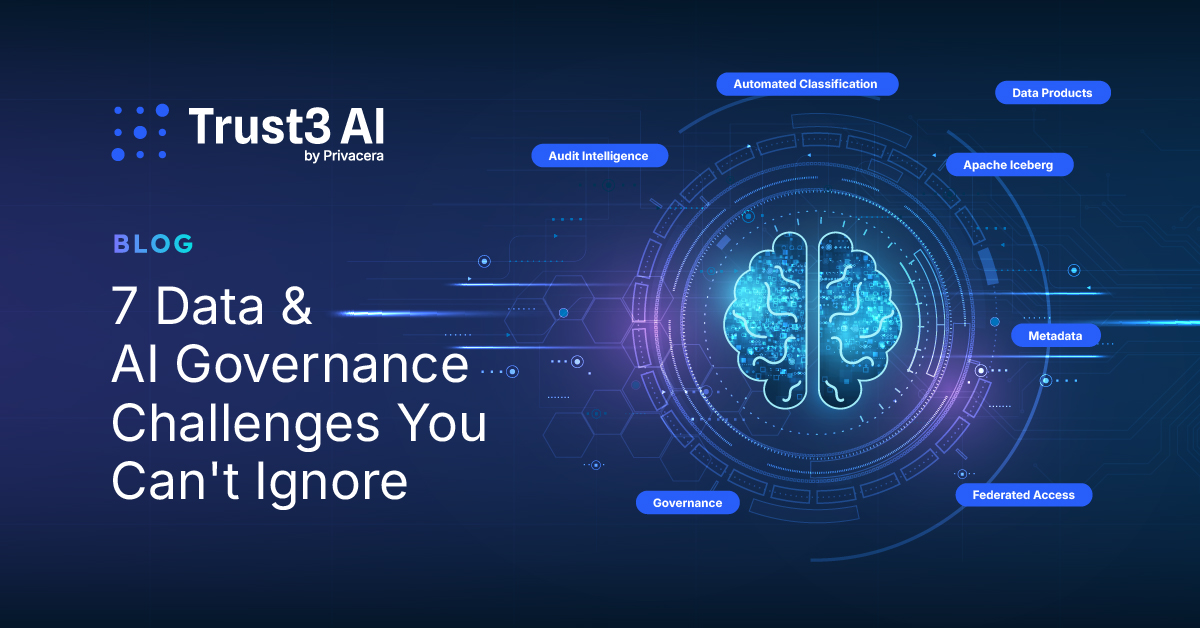
The pressure on data and governance leaders is intense. The enterprise data landscape is experiencing significant shifts, driven by cloud migrations, the integration of artificial intelligence, the risk of data products, and a move toward decentralization. The governance models of the past are struggling to keep pace with the demands of today’s dynamic environment.
Based on work with innovative data leaders, it’s clear that yesterday’s frameworks are no longer sufficient. This blog outlines the seven key challenges shaping the future of Data & AI Governance and explores why now is the critical moment to act. You will learn about the major hurdles organizations face and the modern solutions required to overcome them.
1. The Rise of Data Products and Apache Iceberg
The data stack has evolved. Open table formats like Apache Iceberg are rapidly becoming the enterprise standard, and “data products” are now the primary unit of value exchange. However, governance practices have not caught up to this new reality. Organizations are building sophisticated data products but are trying to govern them with tools designed for raw, unstructured assets.
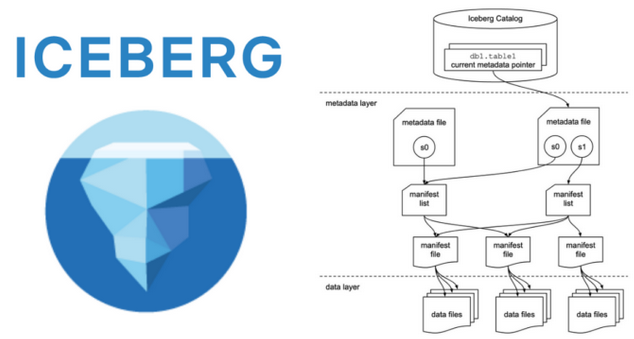
This disconnect creates risk and inefficiency. What organizations need are policy frameworks that support Iceberg out-of-the-box and can extend seamlessly across different query engines. More importantly, they need tools to define and enforce governance at the data product level, ensuring that policies are applied to the curated, high-value assets that drive business decisions.
2. Metadata Chaos Is Undermining Trust
Many enterprises find themselves juggling a complex mix of metadata tools. You might be using Collibra, Alation, Unity Catalog, Polaris, Amundsen, Glue, or Microsoft Fabric. While each of these tools solves a piece of the metadata puzzle, relying on multiple systems often leaves significant gaps and creates a fragmented view of the data landscape.
This metadata chaos undermines trust and makes effective governance nearly impossible. True metadata governance for AI requires a unified control plane that spans all catalogs, clouds, and formats. A system that enforces access is uniquely positioned to provide this foundational context, creating a single source of truth for all metadata and ensuring policies are informed by a complete and accurate picture.
3. The Need for Automated Classification
Manual data classification is not just tedious; it is completely unscalable in the modern data environment. For organizations leveraging AI, the inability to classify data automatically and accurately can be the difference between building safe, compliant systems and facing a reputational disaster. Relying on manual processes introduces human error and cannot keep up with the sheer volume of data being generated.
The solution is AI-native classification that operates at enterprise scale. By automating the discovery and tagging of sensitive data, you can ensure that this critical information feeds directly into your policy engine. This approach, which can be thought of as “PolicyOps with a brain,” enables governance to scale dynamically with your data, ensuring consistent and reliable enforcement without manual intervention.
4. Federated Access Is the New Normal
Today’s data ecosystems are inherently federated. Data and workloads are spread across platforms like Snowflake, Databricks, Amazon Lake Formation, Microsoft Fabric, and Google Cloud. The dream of consolidating everything into a single, centralized platform has proven impractical for most large organizations. Federation is not a temporary trend; it is the new standard.
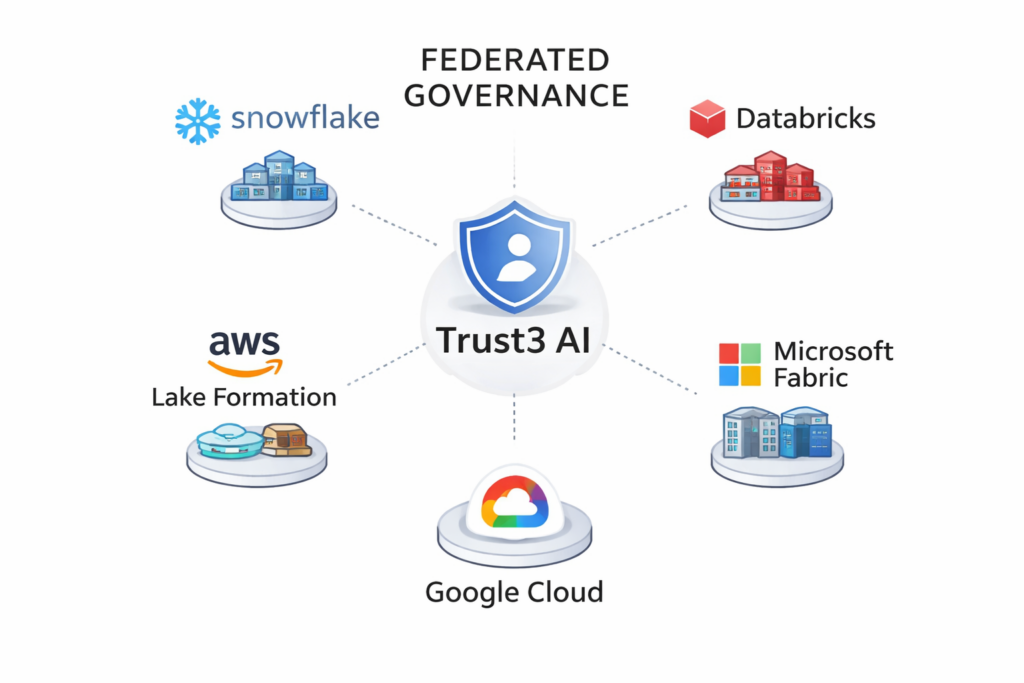
Governing this distributed reality requires a modern policy engine built specifically for federation. You need a system that can connect seamlessly across different platforms, delivering consistent policy enforcement, unified visibility, and large-scale automation. This approach allows you to maintain strong governance without slowing down innovation or sacrificing the agility that federated architectures provide.
5. Governance Must Extend Beyond Data
Leading enterprises are expanding their definition of governance. They recognize that effective control cannot stop at data lakes and tables. True enterprise governance must extend into APIs, applications, and other operational systems. The goal is to establish a consistent policy language and enforcement mechanism across the entire technology stack.
To achieve this, organizations can use a centralized Policy Administration Point (PAP). By leveraging frameworks like Open Policy Agent (OPA), it’s possible to manage both data and application governance from a single pane of glass. This unified approach simplifies management, reduces complexity, and ensures that your governance policies are applied consistently everywhere.
6. Audit Intelligence Over Raw Logs
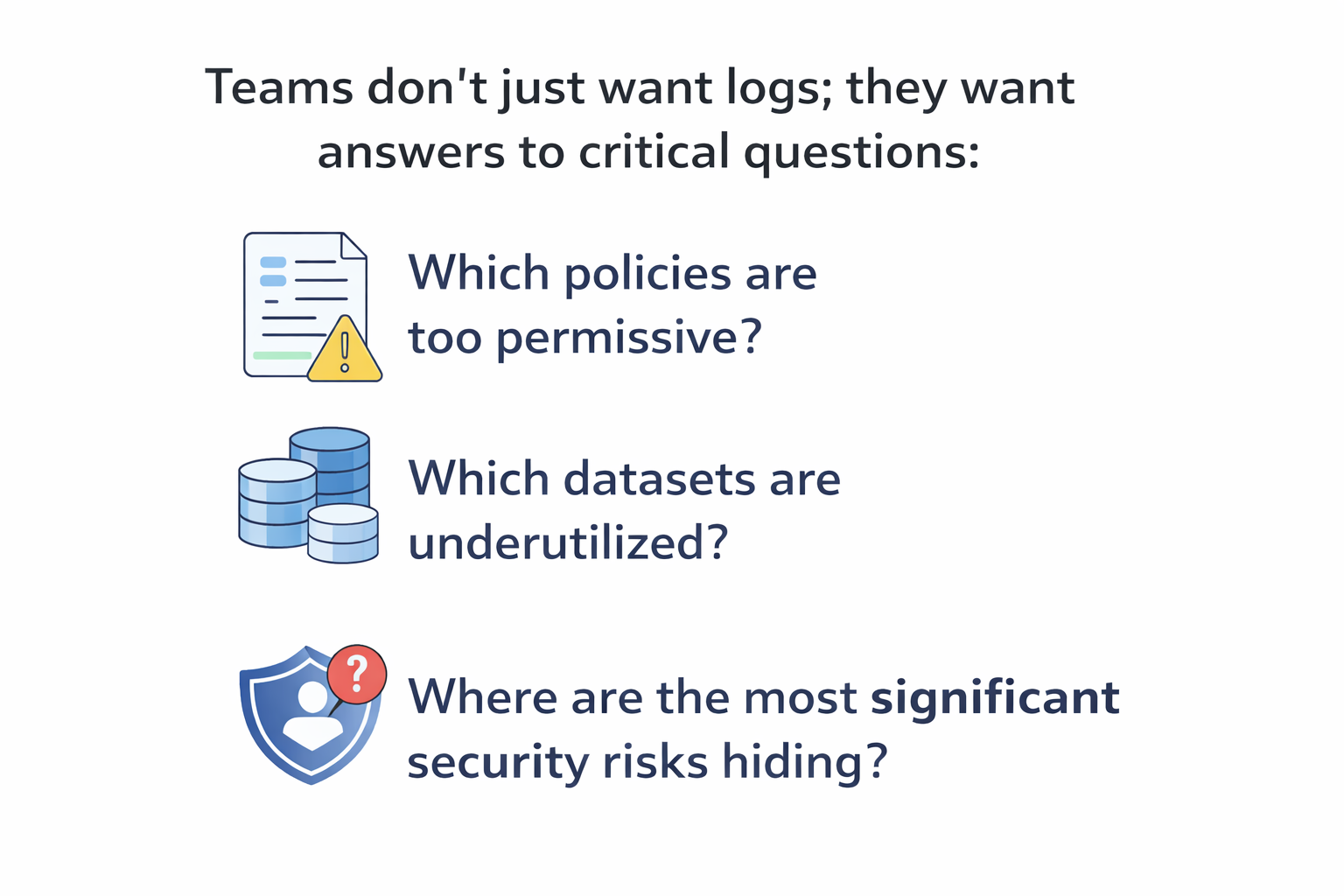
Governance teams are drowning in data. Traditional audit logs generate a massive amount of information but provide very few actionable insights. Teams don’t just want logs; they want answers to critical questions. Which policies are too permissive? Which datasets are underutilized? Where are the most significant security risks hiding?
This is where audit intelligence becomes essential. Instead of simply collecting logs, modern governance platforms can analyze access patterns to surface valuable insights. This intelligence helps you optimize your governance posture, proactively reduce risk, and demonstrate the measurable value of your access control investments. It transforms auditing from a reactive, compliance-driven task into a proactive, strategic function.
7. Closing Open-Source Ranger Gaps in the Cloud
Many organizations that built their on-premises data platforms on HDP/CDP relied on Apache Ranger for access control. As they migrate to cloud platforms like Amazon EMR, Google DataProc, and Azure HDInsight, they are discovering that support for open-source Ranger is limited or being phased out. This leaves a critical gap in their governance and security strategy.
A modern, enterprise-grade solution can bridge this gap. You can retain your Ranger foundation while gaining centralized policy management across both cloud and on-premise environments. This allows for seamless policy federation across platforms like Snowflake, Databricks, Redshift, and BigQuery. It goes beyond simple access control to include automated data discovery, compliance workflows, and format-preserving encryption, delivering a unified governance platform built for the AI era.
Reimagining Governance for the Future
The challenges facing data leaders are significant, but they are not insurmountable. The solutions discussed here do not just patch the problem, they offer a path to transform how you govern data and AI. By embracing automation, federation, and intelligence, you can build a governance framework that enables innovation while ensuring security and compliance. Whether you are a Chief Data Officer, a Governance Leader, or an AI/ML Architect, addressing these challenges head-on will be crucial for success.
Explore how Trust3 AI helps organizations operationalize AI governance and build trusted data foundations. If you’re ready to move beyond experimentation and into production-scale AI, you can also schedule a demo to see how Trust3 supports secure, enterprise-ready AI deployments.