Emerging Tech: The Future of AI Security Is in Securing Agent Actions, Not Prompts
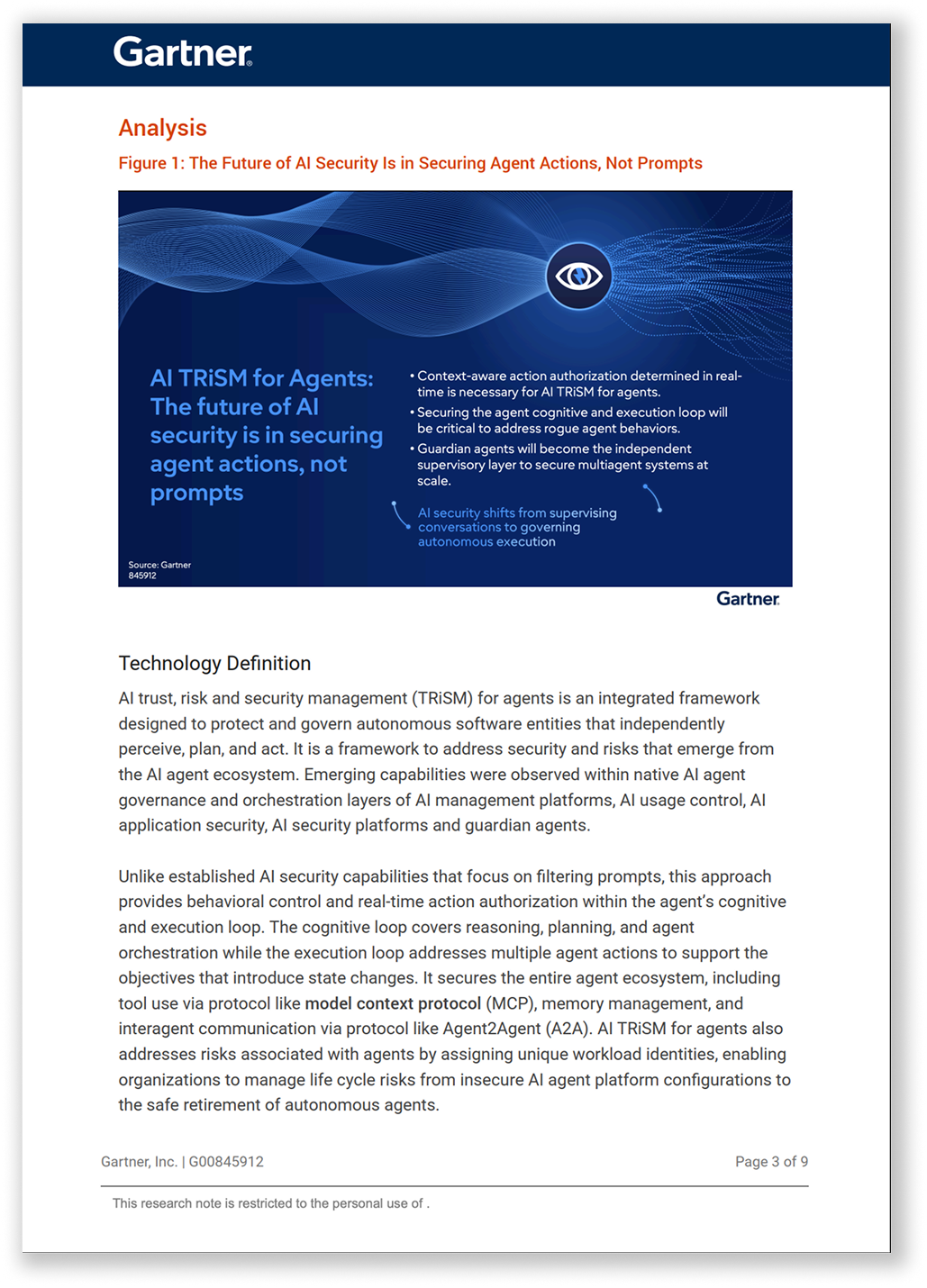
Prompt filtering was built for chatbots. Your agents reason, call tools, and change state without asking. Gartner names what replaces it, and the 2029 deadline for having it in place.
- Why prompt filters miss what agents actually do.
- The access control gap behind agent attacks through 2029.
- Prompt guardrails vs. agent controls, in one table.
- Where guardian agents fit, and when they do not.
- What to require from agent platforms before you scale.
What you'll learn
Three shifts every security and platform leader deploying AI agents needs to plan for.
Context-aware action authorization, in real time
Why static prompt inspection is stateless and multi-turn attacks slip through, and what stateful, behavior-aware authorization looks like at every step of the agent's cognitive loop.
Securing the cognitive and execution loop
The controls that stop rogue behavior at its source: tool misuse, logic and intent drift, infinite loops, goal hijack, and resource burn at machine speed.
Guardian agents as the supervisory layer
How independent, deterministic guardian agents become the mandatory foundation for scaling multi-agent systems beyond human-in-the-loop review.
of successful cyberattacks against AI agents through 2029 will exploit access control issues via prompt injection.
AI TRiSM for agents adoption within AI-native software engineering by 2028, up from less than 5% in 2026.
of enterprise software engineers will rely on agentic coding tools by 2028, the fastest-moving source of ungoverned agents.
The security perimeter just moved.
The report makes the case bluntly: the primary risk is no longer what the AI says, it's what the AI does. Once agents can reason, use tools via MCP, coordinate through A2A, and change state without asking, prompt-layer defenses stop mattering.
“If an AI agent cannot prove who it is acting for and why, it should not get access to tools and data.”
— Gartner, G00845912Trust3 AI was built for exactly this shift. We sit between your agents and everything they touch, enforcing purpose-based access, real-time action authorization, and identity that travels through every hop of the delegation chain.
How Trust3 AI maps to the Gartner framework
Discover every agent
Continuous auto-discovery across Bedrock, Copilot Studio, Databricks, LangChain, Cursor, and beyond. Shadow agents surfaced on first appearance.
Observe every decision
Full-fidelity traces from prompt to retrieval to tool call to response. Real-time detectors for scope drift and behavioral anomalies.
Secure every action
Purpose-based access evaluated per request. Runtime guardrails plus a kill switch on every action. Native MCP and A2A protocol security.
Govern every data source
One policy enforced natively across Snowflake, Databricks, BigQuery, and 50+ more. No proxy hop, no added latency.
The report names the control. See it enforced.
Gartner calls for real-time, context-aware authorization inside the agent's execution loop, with identity that proves purpose before an action fires. That is what the Trust3 AI Unified Trust Layer does, on the gateways you already run. No proxy. No access elevation.
Common questions
What is AI TRiSM for agents?
AI TRiSM for agents is Gartner's framework for governing autonomous software that perceives, plans, and acts. It spans agent discovery, workload identity, real-time action authorization, secure agent communication including MCP and A2A, memory management, and safe retirement.
Why isn't prompt filtering enough for AI agents?
Prompt filters are stateless and inspect text in isolation, so multi-turn attacks slip through. Agents are stateful, take multi-step action across tools and data, and talk to other agents. Some agents have no prompt interface at all and can still cause damage.
What is a guardian agent?
A guardian agent is an independent, deterministic supervisory entity that monitors agent behavior and blocks destructive operations before they execute, rather than reviewing them afterward.
How do you secure agent actions in practice?
Give every agent a verifiable identity and a declared purpose. Authorize each action at runtime against policy. Keep a replayable audit trail from the data platform through the tool call.
Who should read this report?
CISOs, CIOs, security architects, and platform leaders accountable for AI agents that are already running in production.
Gartner, Emerging Tech: The Future of AI Security Is in Securing Agent Actions, Not Prompts, Mark Wah, David Senf, 20 February 2026.
GARTNER is a registered trademark and service mark of Gartner, Inc. and/or its affiliates in the U.S. and internationally and is used herein with permission. All rights reserved. Gartner does not endorse any vendor, product or service depicted in its research publications and does not advise technology users to select only those vendors with the highest ratings or other designation. Gartner research publications consist of the opinions of Gartner's Research & Advisory organization and should not be construed as statements of fact. Gartner disclaims all warranties, expressed or implied, with respect to this research, including any warranties of merchantability or fitness for a particular purpose.
This graphic was published by Gartner, Inc. as part of a larger research document and should be evaluated in the context of the entire document. The Gartner document is available upon request from Trust3 AI.
